Legal link building strategies help law firms earn relevant backlinks, strengthen online authority, increase referral traffic, and improve their overall search visibility. For attorneys competing in competitive local and national search results, a strong backlink profile can support the firm’s broader SEO strategy.
However, effective law firm link building is not about collecting the largest possible number of backlinks. A link from a respected legal publication, local news website, professional association, or relevant industry publication can be considerably more valuable than dozens of links from unrelated websites.
The best legal SEO link building strategies focus on creating something worth referencing and building legitimate relationships with publishers, journalists, organizations, and professional communities.
In other words, the objective is not simply to build links.
The objective is to build authority that naturally earns links.
What Is Legal Link Building?
Legal link building is the process of earning backlinks from external websites to a law firm’s website.
These links can point to:
- The firm’s homepage
- Practice-area pages
- Location pages
- Attorney biographies
- Legal guides
- Research studies
- Statistics pages
- Legal resources
- Interactive tools
For example, a local news publication may quote a personal injury attorney and link to the firm’s accident resource.
A business publication may reference an employment lawyer’s analysis of a new workplace regulation.
A bar association may link to an attorney’s professional profile.
These are examples of legitimate law firm link building because the link has a purpose beyond manipulating search rankings.
Why Is Link Building Important for Law Firms?
Law firm link building can support SEO and marketing in several ways.
Builds External Authority
Links from credible and relevant websites can strengthen the firm’s overall online presence.
Supports Search Visibility
Backlinks remain an important part of how search engines discover and evaluate relationships between websites and content.
Generates Referral Traffic
Relevant links can send prospective clients directly to the firm’s website.
Builds Brand Recognition
External mentions introduce the firm to audiences that may never encounter it through traditional search.
Supports Practice-Area Authority
Backlinks pointing to relevant legal resources can help reinforce the site’s topical relevance.
Creates Professional Relationships
Successful outreach can lead to long-term relationships with journalists, publishers, associations, and industry organizations.
The important point is that backlinks should complement other SEO activities rather than replace quality content, technical SEO, local SEO, or conversion optimization.
What Makes a High-Quality Legal Backlink?
High-quality backlinks for law firms are generally relevant, credible, editorially placed, and useful to the reader.
Before pursuing a backlink, consider:
- Is the website legitimate?
- Is it relevant to the firm’s practice area?
- Is it relevant to the firm’s geographic market?
- Does the website have a real audience?
- Is the content editorially controlled?
- Is the backlink contextually relevant?
- Would the link make sense without SEO?
- Could it generate referral traffic?
A backlink should not be judged solely by Domain Authority (DA) or Domain Rating (DR).
Those metrics can help with research, but they do not tell the complete story.
A relevant website with genuine readership and strong topical alignment can be a better opportunity than a high-metric website that has little connection to the firm’s audience.
15 Legal Link Building Strategies for Law Firms
1. Create Original Legal Research
Original research for law firms can create some of the strongest natural link opportunities.
Journalists, researchers, and publishers need unique information.
Law firms can analyze:
- Court records
- Public data
- Accident statistics
- Consumer surveys
- Employment trends
- Litigation activity
- Regulatory changes
- Legal costs
- State-by-state differences
For example:
2026 Personal Injury Trends Across Major U.S. Cities
A personal injury firm could analyze publicly available data and publish the findings along with its methodology.
Journalists covering transportation safety or personal injury issues now have a reason to reference the research.
That can generate:
Original research → Media coverage → Editorial backlinks → Referral traffic
Original data studies are also useful linkable assets for law firms because other websites can reference the findings when creating their own content.
2. Use Digital PR to Earn Editorial Links
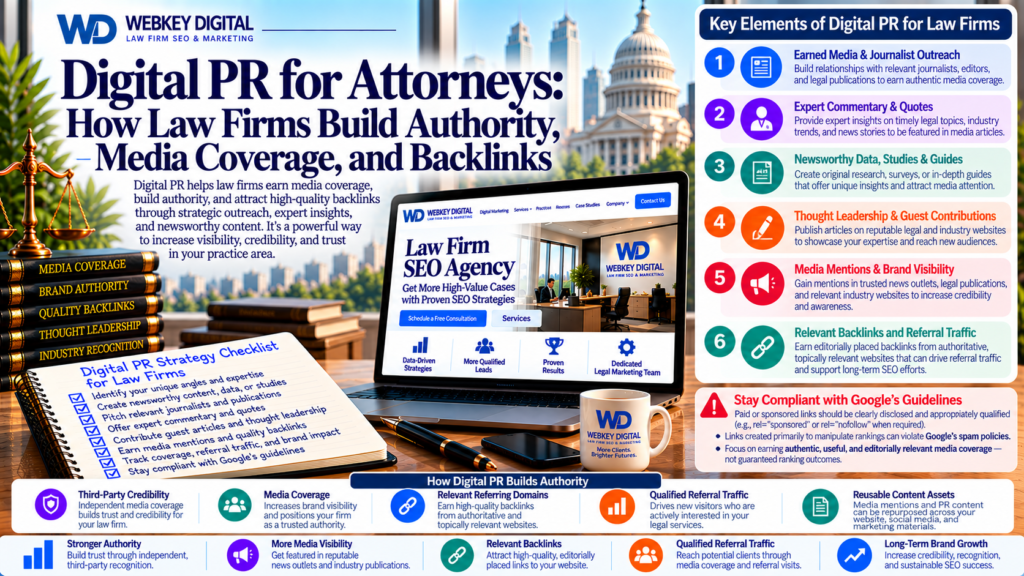
Digital PR for law firms combines public relations, expert knowledge, research, and content to generate media coverage.
Instead of asking hundreds of websites for backlinks, the firm creates something journalists want to cover.
Potential campaigns include:
- Legal research
- Surveys
- Statistics
- Expert commentary
- Industry reports
- Local studies
- Legal trend analysis
The campaign is then presented to relevant journalists and publications.
A successful campaign can generate multiple referring domains from independent websites.
This makes digital PR one of the most effective modern legal link building strategies for firms with original insights or data.
3. Become a Source for Journalists
Journalist outreach for attorneys can produce highly relevant editorial backlinks.
Journalists regularly need attorneys who can explain:
- New laws
- Court decisions
- Regulations
- Consumer issues
- Employment changes
- Business regulations
- Legal trends
An attorney can respond with a short, useful explanation.
A good response should:
- Answer the journalist’s question directly
- Explain the legal issue clearly
- Include relevant credentials
- Avoid unnecessary promotion
- Meet the journalist’s deadline
The objective is to become a reliable expert source.
The backlink is a potential result of the coverage—not the only reason to participate.
4. Contribute to Legal Publications
Legal publication link building allows attorneys to demonstrate expertise while potentially earning relevant editorial links.
Potential opportunities include:
- Legal news websites
- Bar journals
- Legal magazines
- Practice-area publications
- Professional organizations
- Legal research websites
Attorneys can contribute:
- Original analysis
- Expert articles
- Commentary
- Interviews
- Research
- Opinion pieces
The strongest publications have an established audience and editorial process.
Avoid websites that exist primarily to sell backlinks.
5. Pursue Local News Coverage
Local link building for law firms can be particularly valuable for attorneys targeting city-specific searches.
Potential sources include:
- Local newspapers
- Regional news websites
- City magazines
- Local business publications
- Community websites
An attorney can provide commentary about issues affecting local residents.
For example:
What the New Traffic Law Means for Drivers in Miami
A local attorney can explain the legal changes while the publication provides the audience.
This creates an opportunity for:
Local relevance + legal expertise + editorial coverage + referral traffic
6. Build Legitimate Bar Association Links
Bar association backlinks for lawyers can provide strong professional relevance.
Potential opportunities include:
- Member profiles
- Committee pages
- Leadership positions
- Speaking engagements
- CLE programs
- Publications
- Professional resources
The opportunity should come from genuine participation.
Do not pursue a bar association link simply because the domain has a high authority score.
The professional relationship is what makes the link meaningful.
7. Optimize Reputable Legal Directory Profiles
Legal directory link building can provide a useful foundation for a firm’s external presence.
Examples include established legal platforms such as:
- Justia
- FindLaw
- Avvo
- Martindale-Hubbell
- Super Lawyers
- Nolo
The goal is not to submit the firm to hundreds of directories.
Instead, choose reputable directories that:
- Serve legal audiences
- Have established reputations
- Maintain attorney profiles
- Provide useful information
- Can generate referral visibility
Legal directories should be one part of a broader law firm backlink strategy.
8. Create Linkable Legal Resources
Linkable assets for law firms give other websites a legitimate reason to reference the firm’s website.
Useful assets include:
Legal Checklists
Practical checklists for consumers or businesses.
State Comparison Pages
Side-by-side comparisons of laws across jurisdictions.
Legal Statistics
Accurate and regularly updated statistics.
Regulatory Timelines
Important legal deadlines and changes.
Legal Calculators
Useful calculators where appropriate.
Interactive Tools
Tools that solve a specific problem.
Comprehensive Guides
Detailed resources addressing complex legal questions.
Important resources should generally be available as accessible HTML pages rather than existing only as PDFs.
That makes the content easier to search, update, share, and link to.
9. Reclaim Lost Backlinks
Link reclamation for law firms can recover opportunities that already exist.
Look for:
- Broken backlinks
- Old URLs
- Incorrect links
- Former attorney pages
- Old firm names
- Removed pages
- Outdated resource links
For example, a legal publication may still mention the firm but link to an old URL.
A polite request to update the link can recover valuable equity without requiring a completely new outreach campaign.
10. Find Unlinked Brand Mentions
Unlinked mentions for law firms can be another useful source of backlink opportunities.
Search for mentions of:
- Firm names
- Attorney names
- Research studies
- Legal guides
- Firm announcements
- Published reports
If a credible publication already mentions the firm but does not link to it, the firm can contact the publisher and ask whether a relevant link would be useful for readers.
There is no guarantee the publisher will add one.
But because the brand is already mentioned, the outreach has a legitimate reason.
11. Perform a Competitor Backlink Gap Analysis
Competitor backlink analysis for law firms can reveal websites that already reference competing firms.
Start by identifying competitors ranking for important:
- Practice-area keywords
- Location keywords
- Legal questions
- Commercial search terms
Then examine their referring domains.
Look for recurring opportunities such as:
- Legal publications
- Local media
- Industry publications
- Professional associations
- Resource pages
- Podcasts
- Universities
- Community organizations
Do not copy every competitor backlink.
Instead, identify patterns and determine whether the same source is genuinely relevant to your firm.
12. Build Professional Relationships
Professional relationship link building for law firms can produce legitimate opportunities over time.
Potential relationships include:
- Business organizations
- Industry associations
- Nonprofits
- Universities
- Community groups
- Professional organizations
- Local events
For example, an employment lawyer who speaks at an HR association event may legitimately receive a speaker profile containing the attorney’s website.
The link exists because of a real relationship.
That is fundamentally different from creating an artificial partnership purely to obtain backlinks.
13. Use Podcasts and Webinars
Podcast link building for attorneys can provide visibility beyond traditional search.
Lawyers can participate in:
- Legal podcasts
- Business podcasts
- Industry podcasts
- Local podcasts
- Webinars
- CLE events
- Online interviews
A podcast episode page may include:
- Attorney biography
- Firm information
- Website link
- Topic summary
Even when there is no backlink, the appearance can still generate brand awareness and referral opportunities.
The best podcast opportunities are those whose audiences overlap with the firm’s target clients or professional community.
- Use Scholarships Carefully
Scholarship link building for law firms has historically been used by some firms to obtain links from educational websites.
However, this strategy should not be treated as a shortcut to .edu backlinks.
If a law firm genuinely offers a scholarship that supports students and has legitimate eligibility criteria, the scholarship can be a worthwhile community initiative.
The link should be a byproduct of the legitimate program.
Creating a scholarship solely because it may produce educational backlinks is a poor long-term strategy.
The same principle applies to .gov links:
The domain extension alone does not make a backlink valuable.
Relevance, legitimacy, editorial context, and the reason for the link matter more.
15. Develop Industry-Specific Link Opportunities
Industry link building for law firms can be particularly effective for attorneys serving business clients.
A healthcare attorney could contribute to a healthcare publication.
An employment attorney could provide commentary to an HR website.
A real estate attorney could contribute to a property publication.
A technology attorney could write for a technology or startup publication.
This creates a powerful combination:
Legal expertise + Industry relevance + Target audience
It can also bring qualified referral traffic rather than simply increasing backlink numbers.
Guest Posting as a Legal Link Building Strategy
Guest posting for law firms can still be useful when it is done selectively.
A lawyer might contribute an original article to:
- A reputable legal publication
- An industry publication
- A business website
- A professional organization
The publication should have:
- A real audience
- Relevant topics
- Editorial standards
- Original content
- A legitimate reason to publish the attorney’s expertise
Avoid networks that publish large numbers of generic guest posts solely to sell backlinks.
How to Evaluate a Legal Backlink
Evaluating backlinks for law firms should involve more than checking DA or DR.
Consider these factors.
1. Relevance
Does the website relate to law, the practice area, industry, or location?
2. Organic Visibility
Does the website appear to receive search traffic?
3. Content Quality
Is the website publishing useful, original information?
4. Editorial Standards
Does the publication appear selective about what it publishes?
5. Link Placement
Is the backlink naturally incorporated into the content?
6. Outbound Link Patterns
Does the website link to many unrelated businesses or appear to sell links?
7. Referral Potential
Could real users click the link?
8. Longevity
Is the page likely to remain online?
9. Brand Reputation
Would your law firm be comfortable being associated with the website?
A backlink should pass this broader quality assessment before being added to a campaign.
What Is a Good Anchor Text Strategy for Law Firms?
Law firm backlink anchor text should look natural.
Suppose the target page is:
Personal Injury Lawyer in Chicago
It would not be natural for every external website to use the exact phrase:
personal injury lawyer Chicago
A natural backlink profile may include:
- Firm name
- Attorney name
- Brand name
- Page title
- Partial-match phrases
- Natural descriptive text
- URL
The publisher should choose the wording that makes sense for its readers.
The goal is not to control every anchor text.
The goal is to earn editorially natural references.
Dofollow vs. Nofollow Links for Law Firms
Dofollow and nofollow backlinks for law firms can both have value, although they serve different purposes.
A standard editorial link can potentially contribute to the site’s link signals.
A nofollow, sponsored, or ugc link may not pass the same ranking signals, but it can still provide:
- Referral traffic
- Brand exposure
- Media visibility
- Potential client discovery
- Additional online recognition
Therefore, law firms should not reject a worthwhile media opportunity simply because the publisher uses a nofollow attribute.
The quality and relevance of the relationship can still make the placement valuable.
What Legal Link Building Strategies Should Law Firms Avoid?
Some tactics create more risk than value.
Private Blog Networks
PBN link building for law firms relies on networks of websites controlled primarily for manipulating rankings.
Avoid them.
Link Farms
Websites created primarily to exchange or sell links provide little legitimate value.
Mass Directory Submissions
Submitting a website to hundreds of unrelated directories is not a quality strategy.
Bulk Guest Posts
Large-scale publishing on low-quality websites can produce an unnatural backlink profile.
Exact-Match Anchor Manipulation
Forcing the same keyword into every backlink is unnecessary and potentially unnatural.
Cheap Backlink Packages
Be skeptical of offers such as:
“500 high-DA backlinks for $99.”
A large number of backlinks does not equal a strong backlink profile.
Should Law Firms Buy Backlinks?
Buying backlinks for law firm SEO should be approached carefully.
There is a difference between paying for:
- Advertising
- Sponsorship
- Event promotion
- Legitimate media placement
and paying a website specifically to manipulate organic rankings.
Law firms should be cautious about providers promising:
- Guaranteed rankings
- Hundreds of backlinks every month
- Private blog networks
- Bulk guest posts
- Guaranteed high-DA links
A sustainable legal link building strategy should prioritize earned editorial links, useful resources, professional relationships, and legitimate media exposure.
How to Build a Legal Link Building Campaign
A practical law firm link building strategy can follow this process.
Step 1: Identify Priority Pages
Choose the practice-area and location pages that matter most to the firm’s SEO goals.
Step 2: Analyze Competitors
Review the referring domains of firms ranking for the target searches.
Step 3: Find Link Opportunities
Categorize potential sources:
- Legal publications
- Local media
- Bar associations
- Industry publications
- Directories
- Resource pages
- Professional organizations
Step 4: Create Something Worth Linking To
Develop:
- Original research
- Data studies
- Legal guides
- Tools
- Statistics
- Expert analysis
Step 5: Conduct Outreach
Contact the appropriate journalists, editors, organizations, or publishers.
Step 6: Earn Coverage
Provide genuine value rather than requesting links without context.
Step 7: Reclaim Existing Opportunities
Find broken links and unlinked mentions.
Step 8: Measure Results
Track both SEO and business outcomes.
How Many Backlinks Does a Law Firm Need?
How many backlinks a law firm needs depends on the competitive environment.
A personal injury lawyer in New York may need a different authority profile from an estate planning attorney serving a smaller city.
Instead of choosing an arbitrary number, analyze:
- Referring domains
- Link quality
- Topical relevance
- Local relevance
- Editorial authority
- Competitor profiles
- Target keywords
The goal is not:
Build 1,000 backlinks.
The goal is:
Build a stronger, more relevant authority profile than the pages competing for the firm’s target searches.
How Long Does Legal Link Building Take?
Legal link building is generally a long-term SEO activity.
Some opportunities can happen quickly:
- Unlinked mention reclamation
- Existing professional profiles
- Journalist requests
- Legitimate directory profiles
Others can take considerably longer:
- Original research
- Digital PR campaigns
- Journalist relationships
- Industry partnerships
- Thought leadership
A consistent approach is usually more sustainable than building a large number of links in a short period and then stopping.
How to Measure Legal Link Building Results
Law firm backlink reporting should measure more than the number of links acquired.
Track:
| Metric | Purpose |
|---|---|
| Referring domains | Measures domain diversity |
| Relevant referring domains | Measures topical relevance |
| Editorial backlinks | Measures earned coverage |
| Referral traffic | Measures user interest |
| Brand mentions | Measures visibility |
| Attorney mentions | Measures thought leadership |
| Rankings | Measures search performance |
| Organic traffic | Measures visibility |
| Leads | Measures business opportunities |
| Qualified leads | Measures lead quality |
| Signed cases | Measures business impact |
The most important question is not:
How many links did we build?
It is:
Did the link-building campaign improve the firm’s visibility and contribute to qualified business opportunities?
Legal Link Building Checklist
Use this checklist before pursuing a backlink.
Website Quality
- Website is legitimate
- Website has relevant content
- Website has a real audience
- Website has credible editorial standards
Link Relevance
- Linking page is relevant
- Anchor text is natural
- Link fits the surrounding content
- Target page is useful
Strategy
- Competitor backlink gap analyzed
- Link opportunity categorized
- Outreach is personalized
- Content provides genuine value
Risk
- No PBNs
- No link farms
- No mass directory submissions
- No manipulative anchor text
- No suspicious bulk backlink packages
Measurement
- Referring domains tracked
- Backlinks tracked
- Referral traffic tracked
- Rankings tracked
- Leads tracked
- Business results tracked
Frequently Asked Questions
What are the best legal link building strategies?
The best legal link building strategies include original research, digital PR, expert commentary, legal publications, local news outreach, bar associations, reputable legal directories, link reclamation, resource pages, podcasts, professional relationships, and industry-specific publications.
How can a law firm get high-quality backlinks?
A law firm can earn high-quality backlinks by creating useful resources, publishing original research, providing expert commentary, contributing to reputable publications, participating in professional organizations, and developing genuine relationships with relevant websites.
Are legal directories good for law firm SEO?
Yes. Legal directory backlinks from reputable platforms can provide foundational visibility and referral opportunities. They should be part of a broader backlink strategy rather than the firm’s only source of links.
Are backlinks still important for law firm SEO?
Yes. Law firm backlinks remain an important part of a broader SEO strategy, but quality, relevance, context, and referring-domain diversity are more meaningful than simply increasing backlink volume.
Should law firms buy backlinks?
Law firms should be cautious about purchasing backlinks specifically to manipulate organic rankings. Legal link building is more sustainable when it focuses on editorial coverage, useful content, digital PR, professional relationships, and legitimate industry participation.
Are .edu backlinks better for law firms?
Not automatically. A law school backlink can be valuable when it comes from a genuine educational relationship, but the .edu extension itself does not make a link inherently better.
Are guest posts useful for legal SEO?
Guest posting for law firms can be useful when the publication is reputable, relevant, and genuinely editorial. Generic guest-post networks created primarily for backlinks should be avoided.
How many backlinks does a law firm need?
There is no universal number. Law firm link building should be based on the firm’s practice area, location, competitors, target keywords, referring domains, and backlink quality.
What is the safest way to build backlinks for a law firm?
The safest approach is to earn links through original research, digital PR, expert commentary, reputable publications, professional organizations, useful resources, legitimate directories, and genuine relationships.
Final Thoughts on Legal Link Building Strategies
Legal link building strategies work best when they are built around something a law firm already has: professional expertise.
Attorneys understand complex legal issues that journalists, businesses, organizations, and consumers need explained.
That expertise can become:
Original research
- Expert commentary
- Digital PR
- Thought leadership
- Legal resources
- Professional relationships
- Editorial coverage
Those activities can naturally produce relevant backlinks while strengthening the firm’s broader online presence.
The goal of law firm link building should not be to accumulate the highest possible number of links.
It should be to develop a backlink profile that is:
Relevant. Authoritative. Diverse. Editorial. Natural.
For WebKeyDigital, this article should sit alongside the other pages in your law firm SEO cluster without competing directly with them:
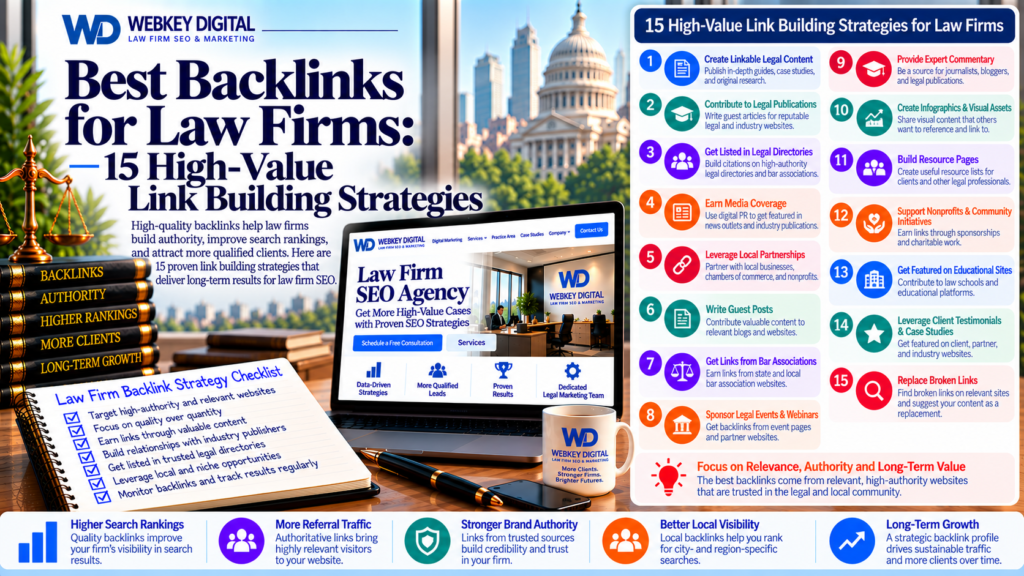
- Best Backlinks for Law Firms → explains which backlink sources are valuable
- Legal Link Building Strategies → explains how law firms can earn those backlinks
- Digital PR for Attorneys → explains how research, media relations, and attorney expertise can generate authority and coverage
That distinction gives each page a different search intent while allowing them to support one another through strategic internal linking.
Ultimately, successful legal SEO link building is not about finding a shortcut to higher rankings.
It is about creating valuable information, demonstrating genuine expertise, and earning recognition from websites that have a legitimate reason to reference the law firm.