PPC Mistakes Lawyers Make: 15 Costly Errors That Waste Law Firm Advertising Budgets

PPC mistakes lawyers make can quickly turn a promising paid advertising campaign into an expensive source of irrelevant clicks, unqualified leads, and missed cases. Because legal keywords can be highly competitive, poor campaign settings can waste hundreds or thousands of dollars before a firm realizes something is wrong.

PPC for lawyers can generate highly targeted traffic and potential clients, but successful campaigns require more than selecting a few legal keywords and writing an advertisement. The targeting, ad copy, landing page, conversion tracking, budget, and intake process all affect whether paid traffic turns into actual business.

Law firm PPC mistakes also extend beyond the Google Ads account. A campaign may generate plenty of clicks and leads but still perform poorly if the firm sends visitors to the wrong page, fails to track phone calls, attracts people outside its service area, or does not follow up with leads promptly.

This guide covers the most common PPC mistakes lawyers make, why they waste advertising budgets, and what law firms can do instead.

The Most Common PPC Mistakes Lawyers Make

PPC mistakes lawyers make generally fall into four areas:

  1. Targeting the wrong searches
  2. Building poorly structured campaigns
  3. Sending traffic to weak landing pages
  4. Measuring the wrong results

Here are the mistakes law firms should look for first.

1. Sending PPC Traffic to the Homepage

Sending PPC traffic to the homepage is one of the most common mistakes lawyers make.

Imagine someone searches:

Dallas car accident lawyer

They click an advertisement and land on a homepage that talks about:

  • Personal injury
  • Criminal defense
  • Family law
  • Estate planning
  • Employment law
  • Business law

The visitor now has to find the service they were originally searching for.

That creates unnecessary friction.

Law firm PPC landing pages should instead match the search intent.

For example:

Car Accident Lawyer Ad

→ Car Accident Lawyer Landing Page

DUI Lawyer Ad

→ DUI Defense Landing Page

Divorce Lawyer Ad

→ Divorce Attorney Landing Page

Foster Web Marketing identifies sending paid traffic to a general homepage rather than a targeted landing page as one of the major PPC mistakes law firms make.

How to fix it

Create dedicated landing pages for important practice areas and high-value campaigns.

2. Not Using Negative Keywords

Negative keywords for lawyers help prevent advertisements from appearing for irrelevant searches.

For example, a law firm bidding on:

personal injury lawyer

may not want to pay for searches related to:

  • Personal injury lawyer jobs
  • Personal injury lawyer salary
  • Personal injury law school
  • Free personal injury advice
  • Personal injury forms
  • DIY personal injury claim

PPC for lawyers can become expensive when the campaign pays for clicks from people who are not potential clients.

How to fix it

Build a negative keyword list and regularly review the search terms report.

Depending on the practice area, negative keywords may include terms such as:

  • jobs
  • salary
  • career
  • school
  • degree
  • free
  • DIY
  • template
  • form
  • definition

The exact list should depend on the firm’s services and campaign data.

Foster specifically recommends negative keywords to filter unwanted clicks and improve the quality of PPC traffic.

3. Targeting Locations Too Broadly

Local PPC for lawyers should be based on the firm’s actual service area.

A firm might primarily serve:

  • Dallas County
  • Houston
  • Phoenix
  • Chicago
  • A group of nearby communities

but advertise across an entire state.

That can generate impressions and clicks from people the firm does not want to serve.

Law firm PPC targeting should consider:

  • Cities
  • Counties
  • Service areas
  • Office locations
  • Appropriate radius targeting
  • Location exclusions

Foster’s PPC guidance specifically warns that overly broad geographic targeting can produce more traffic without producing better leads.

How to fix it

Start with the firm’s strongest service areas and expand only when performance data supports expansion.

4. Mixing Too Many Practice Areas Into One Campaign

Law firm PPC campaign structure should reflect meaningful differences between services.

A campaign containing:

  • Personal injury
  • Criminal defense
  • Divorce
  • Estate planning

makes it harder to control:

  • Budget
  • Keywords
  • Ads
  • Landing pages
  • Search intent

Instead, structure campaigns around meaningful services.

Example

Personal Injury Campaign

  • Car Accident
  • Truck Accident
  • Motorcycle Accident

Criminal Defense Campaign

  • DUI
  • Drug Charges
  • Federal Defense

Family Law Campaign

  • Divorce
  • Child Custody
  • Child Support

Hennessey recommends organizing Google Ads around relevant ad groups and practice-area services rather than treating every legal service as one broad campaign.

5. Using Broad Keywords Without Enough Control

Broad keyword targeting for lawyers can attract searches that are related to a legal term but do not necessarily represent someone looking to hire the firm.

For example, a firm targeting:

workers compensation lawyer

could potentially attract searches related to:

  • Workers compensation laws
  • Workers compensation definition
  • Workers compensation forms
  • Workers compensation jobs

Not all of these searches have the same commercial intent.

How to fix it

PPC for law firms should combine carefully selected keywords with:

  • Negative keywords
  • Search-term analysis
  • Appropriate match types
  • Geographic targeting
  • Relevant landing pages

Do not assume that more search volume automatically means more potential clients.

6. Writing Generic Ad Copy

Google Ads for lawyers need to give searchers a reason to choose the firm’s advertisement.

A generic advertisement such as:

Experienced Attorneys
Contact Our Law Firm
Free Consultation

does not communicate much.

A more targeted advertisement might say:

Dallas Car Accident Lawyer
Speak With an Experienced Injury Attorney
Schedule a Case Review

The advertisement immediately communicates:

  • Practice area
  • Location
  • Service
  • Next action

Law firm PPC advertising should align the ad with the specific search intent.

Clio also recommends testing different ad versions and using compelling copy and calls to action rather than assuming the first version will be the best performer.

7. Not Matching the Ad to the Landing Page

PPC mistakes lawyers make often occur when the advertisement and landing page promise different things.

For example:

Ad:

Dallas Truck Accident Lawyer

Landing Page:

Personal Injury Law Firm

The page may technically be relevant, but it does not directly answer the user’s search.

A better structure is:

Search

→ Truck Accident Lawyer Dallas

Ad

→ Dallas Truck Accident Attorney

Landing Page

→ Truck Accident Lawyer in Dallas

CTA

→ Request a Consultation

Law firm PPC landing pages should provide a consistent experience from search to conversion.

Hennessey similarly emphasizes aligning targeting, ad copy, and landing-page content with the firm’s intended audience and services.

8. Failing to Track Phone Calls

Call tracking for lawyers is essential because phone calls can be one of the most important conversion actions for a law firm.

A campaign may appear to generate few conversions if the firm tracks only online forms.

A complete system should ideally measure:

  • Calls
  • Forms
  • Consultation requests
  • Qualified leads
  • Signed cases

Law firm PPC tracking should connect advertising activity with what happens after someone contacts the firm.

Foster identifies ineffective lead tracking as a major PPC problem because firms can otherwise lose track of the leads they have already paid to acquire.

9. Measuring Leads Instead of Signed Cases

PPC mistakes lawyers make often include focusing on the number of leads rather than their quality.

Consider:

Campaign A

100 leads
5 signed cases

Campaign B

40 leads
10 signed cases

Campaign A generated more leads.

Campaign B generated twice as many clients.

Law firm PPC ROI should therefore be evaluated through the full funnel:

Click → Lead → Qualified Lead → Consultation → Signed Case

The most useful question is not:

How many leads did PPC generate?

It is:

How many qualified cases did PPC generate at an acceptable acquisition cost?

Hennessey likewise emphasizes monitoring conversions and other meaningful KPIs rather than relying on surface-level advertising activity.

10. Setting Up Conversion Tracking Incorrectly

Conversion tracking for law firm PPC needs to distinguish meaningful actions from low-value interactions.

A firm might track:

  • Contact form submissions
  • Phone calls
  • Consultation requests
  • Appointment bookings

But not every form submission represents a viable legal matter.

For example:

“Can you give me free legal advice?”

and

“I was injured in a truck accident last week and need an attorney.”

should not necessarily have the same business value.

How to fix it

Where technically and operationally feasible, connect PPC data with the firm’s intake or CRM system so the firm can distinguish:

Lead

from

Qualified Lead

from

Signed Client

11. Ignoring the Search Terms Report

Search terms analysis for lawyers can reveal exactly what users searched before clicking an advertisement.

The report can identify:

  • Irrelevant searches
  • Unexpected practice areas
  • Informational searches
  • Job searches
  • Competitor searches
  • Poor geographic matches
  • New high-intent opportunities
How to fix it

Review search terms regularly and:

  • Add negative keywords
  • Improve keyword targeting
  • Adjust match types
  • Identify useful new keywords
  • Remove waste

PPC management for lawyers should become more precise as actual search data accumulates.

12. Setting the Campaign and Forgetting About It

Set-and-forget PPC for lawyers is one of the most expensive mistakes a law firm can make.

Search behavior changes.

Competitors change.

CPCs change.

Budgets change.

New search terms appear.

Landing pages can decline in performance.

Law firm PPC management therefore requires ongoing optimization.

Foster calls setting campaigns live and then ignoring them the biggest mistake it sees among lawyers using PPC. Hennessey similarly emphasizes regular monitoring and adjustment.

Review regularly:
  • Search terms
  • Negative keywords
  • CPC
  • CTR
  • Conversion rate
  • Lead quality
  • Location performance
  • Device performance
  • Budget
  • Cost per qualified lead
  • Cost per signed case

13. Focusing Only on Click-Through Rate

PPC mistakes lawyers make can also involve overvaluing CTR.

A high CTR means people are clicking.

It does not necessarily mean they are becoming clients.

For example:

Campaign A

CTR: 8%
Conversion rate: 2%

Campaign B

CTR: 5%
Conversion rate: 10%

Campaign B may be substantially more valuable despite having a lower CTR.

Google Ads for law firms should use CTR as a diagnostic metric rather than the ultimate business goal.

14. Ignoring Mobile Landing Page Performance

Mobile PPC for lawyers deserves special attention because a potential client may search for an attorney from a smartphone and want to call immediately.

Check whether mobile visitors can:

  • Read the page easily
  • Find the phone number
  • Tap to call
  • Complete a form
  • Navigate quickly
  • Understand the firm’s service
  • See the primary CTA

Law firm PPC landing pages should be designed around the user’s next action rather than simply presenting a large amount of information.

15. Failing to Test Ads and Landing Pages

PPC testing for lawyers should be ongoing.

Test:

  • Headlines
  • Descriptions
  • Calls to action
  • Landing-page headlines
  • Form length
  • Phone placement
  • Trust elements
  • Page structure

For example:

CTA A:

Request a Free Consultation

versus

CTA B:

Speak With a Lawyer Today

The better option should be determined by actual conversion data.

Clio recommends testing different ad versions and reallocating budget based on performance.

16. Using the Same Budget for Every Practice Area

PPC budget allocation for lawyers should reflect campaign economics.

Personal injury, criminal defense, family law, and estate planning may have very different:

  • CPCs
  • Search volumes
  • Conversion rates
  • Case values
  • Competition

Giving each practice area exactly 25% of the budget may not be the best strategy.

Instead, analyze:

Cost per qualified lead

Cost per consultation

Cost per signed case

Then allocate additional budget to campaigns that can support profitable growth.

17. Choosing the Wrong Advertising Platform

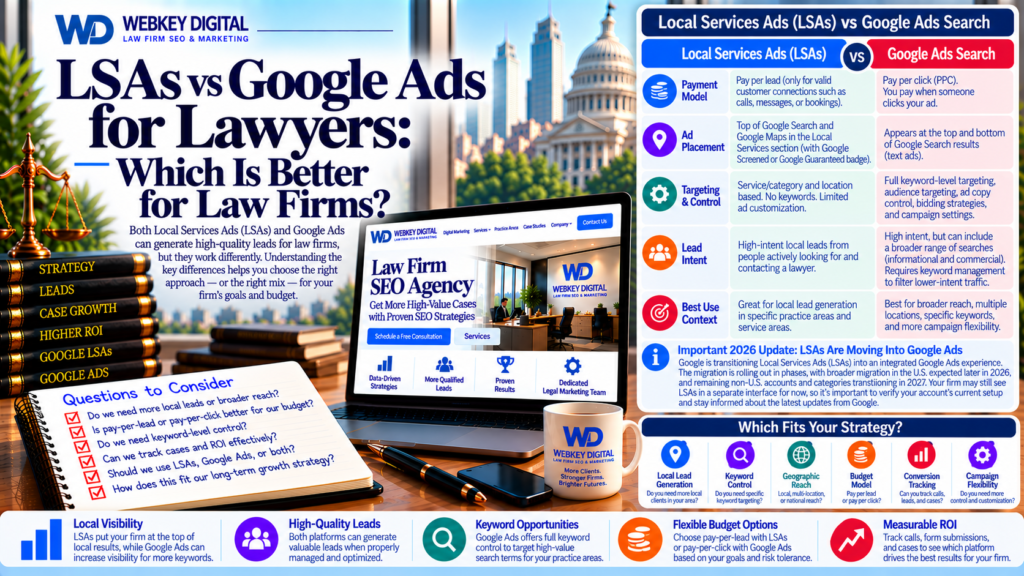
PPC for lawyers is not limited to Google Search.

Depending on the firm’s audience and goals, possible platforms include:

  • Google Ads
  • Microsoft Ads
  • Local Services Ads
  • Meta
  • LinkedIn
  • YouTube

But the firm should not advertise everywhere simply because the platforms are available.

Hennessey recommends choosing platforms based on where the firm’s prospective clients actually search or spend time online.

Better approach

Start with the channel most closely aligned with the firm’s client acquisition behavior.

For many local legal services, that may be Google Search and Local Services Ads.

18. Ignoring the Intake Process

Law firm PPC lead management does not stop when someone submits a form.

A paid lead still needs to be handled.

A firm can lose a valuable lead because:

  • Nobody answered the phone
  • The callback happened too late
  • The form was not routed correctly
  • The intake team did not follow up
  • The lead was not properly qualified

PPC for lawyers should therefore be connected to an efficient intake process.

Track:

Lead → Contacted → Qualified → Consultation → Retained

This gives the firm a much clearer picture of PPC performance.

19. Not Considering the Cost Per Signed Case

PPC mistakes lawyers make often begin with evaluating advertising using CPC or CPL alone.

A better hierarchy is:

CPC

↓

Cost Per Lead

↓

Cost Per Qualified Lead

↓

Cost Per Consultation

↓

Cost Per Signed Case

The final figure is often the most useful for deciding whether a campaign deserves additional budget.

20. Expecting Immediate Perfect Results

PPC for lawyers can produce traffic quickly, but that does not mean the first campaign configuration will be perfect.

Campaigns need data.

Law firms may discover:

  • Unexpected search terms
  • Better-performing locations
  • Better-performing practice areas
  • Poor-performing keywords
  • Stronger ad messaging
  • Better landing pages

Clio specifically notes that successful campaigns require time and testing and that firms should expect a learning phase.

The goal is not perfection on launch day.

The goal is continuous improvement.

PPC Mistakes Lawyers Make: Quick Audit Checklist

PPC mistakes lawyers make can be identified quickly using this checklist.

Keywords

  • High-intent searches prioritized
  • Negative keywords added
  • Search terms reviewed
  • Irrelevant searches excluded

Targeting

  • Correct locations
  • Correct practice areas
  • Appropriate campaign segmentation
  • Relevant audiences

Ads

  • Practice area clearly stated
  • Location included where appropriate
  • Strong CTA
  • Relevant keywords
  • Multiple variations tested

Landing Pages

  • Dedicated landing pages
  • Ad-to-page relevance
  • Mobile-friendly
  • Clear CTA
  • Trust signals
  • Easy contact options

Tracking

  • Form tracking
  • Call tracking
  • Consultation tracking
  • Qualified lead tracking
  • Signed-case tracking

Management

  • Search terms reviewed
  • Negative keywords updated
  • CPC monitored
  • Conversion rate monitored
  • Lead quality reviewed
  • Budget adjusted
  • Landing pages tested

How to Fix PPC Mistakes Lawyers Make

Fixing PPC mistakes for lawyers should happen in a logical order.

Step 1: Stop Wasted Spend

Identify irrelevant keywords, locations, and search terms.

Step 2: Fix Conversion Tracking

Make sure forms, calls, and consultations are measured.

Step 3: Improve Campaign Structure

Separate important practice areas and locations.

Step 4: Improve Ad Relevance

Make advertisements directly address the searcher’s intent.

Step 5: Build Better Landing Pages

Match every important campaign with a focused page.

Step 6: Improve Intake

Make sure qualified leads are contacted quickly.

Step 7: Reallocate Budget

Move spending toward campaigns producing better-qualified opportunities.

Step 8: Keep Testing

Continue testing ads, keywords, landing pages, and budgets.

PPC Mistakes Lawyers Make: Final Checklist

PPC for lawyers should pass these five tests:

1. Is the right person seeing the advertisement?

Check keywords, locations, and negative keywords.

2. Does the advertisement match the search?

Check ad copy and practice-area relevance.

3. Does the landing page match the advertisement?

Check page relevance and conversion experience.

4. Can you track what happens after the click?

Check calls, forms, consultations, and qualified leads.

5. Are the resulting cases profitable?

Check cost per signed case and revenue.

If any answer is “no,” the campaign has an optimization opportunity.

Frequently Asked Questions

What is the biggest PPC mistake lawyers make?

The biggest PPC mistake lawyers make is often treating PPC as a set-it-and-forget-it channel. Campaigns need ongoing search-term analysis, negative keyword management, budget adjustments, testing, and conversion analysis. Foster Web Marketing specifically identifies this as a major issue among law firms.

Why are law firm PPC campaigns expensive?

PPC for lawyers can be expensive because legal search terms can have strong commercial intent and significant competition. CPCs vary considerably by practice area and market.

Should lawyers send Google Ads traffic to their homepage?

Usually, law firm PPC landing pages should be more specific than the homepage. A visitor searching for a particular legal service should generally reach a page focused on that service and its relevant location.

How can lawyers reduce wasted PPC spend?

Reducing wasted PPC spend starts with negative keywords, focused geographic targeting, relevant campaign structure, search-term analysis, dedicated landing pages, and accurate conversion tracking.

Should lawyers manage PPC themselves?

Lawyer PPC management can be handled internally if the firm has the expertise and time to monitor campaigns consistently. Otherwise, experienced PPC management can help with targeting, testing, tracking, and optimization.

Final Thoughts on PPC Mistakes Lawyers Make

PPC mistakes lawyers make can be expensive because legal advertising often involves competitive keywords and high CPCs. The biggest problems are not necessarily complicated technical errors. They are often basic mistakes: sending traffic to the wrong page, targeting too broadly, ignoring negative keywords, failing to track leads, and launching campaigns without ongoing management.

PPC for lawyers works best when every stage of the process is connected:

Keyword → Ad → Landing Page → Lead → Intake → Consultation → Signed Case

Foster Web Marketing’s current PPC guidance emphasizes targeted landing pages, lead tracking, negative keywords, geographic specificity, and continuous campaign management, while Hennessey emphasizes targeting, campaign structure, ad relevance, budget management, and ongoing optimization.

Law firm PPC strategy should also recognize that not every click, lead, or conversion has equal value. A campaign that generates fewer but better-qualified cases can outperform one producing a much larger number of inexpensive leads.
PPC Mistakes Lawyers Make: 15 Costly Errors That Waste Law Firm Advertising Budgets

PPC mistakes lawyers make can quickly turn a promising paid advertising campaign into an expensive source of irrelevant clicks, unqualified leads, and missed cases. Because legal keywords can be highly competitive, poor campaign settings can waste hundreds or thousands of dollars before a firm realizes something is wrong.

PPC for lawyers can generate highly targeted traffic and potential clients, but successful campaigns require more than selecting a few legal keywords and writing an advertisement. The targeting, ad copy, landing page, conversion tracking, budget, and intake process all affect whether paid traffic turns into actual business.

Law firm PPC mistakes also extend beyond the Google Ads account. A campaign may generate plenty of clicks and leads but still perform poorly if the firm sends visitors to the wrong page, fails to track phone calls, attracts people outside its service area, or does not follow up with leads promptly.

This guide covers the most common PPC mistakes lawyers make, why they waste advertising budgets, and what law firms can do instead.

The Most Common PPC Mistakes Lawyers Make

PPC mistakes lawyers make generally fall into four areas:

  1. Targeting the wrong searches
  2. Building poorly structured campaigns
  3. Sending traffic to weak landing pages
  4. Measuring the wrong results

Here are the mistakes law firms should look for first.

1. Sending PPC Traffic to the Homepage

Sending PPC traffic to the homepage is one of the most common mistakes lawyers make.

Imagine someone searches:

Dallas car accident lawyer

They click an advertisement and land on a homepage that talks about:

  • Personal injury
  • Criminal defense
  • Family law
  • Estate planning
  • Employment law
  • Business law

The visitor now has to find the service they were originally searching for.

That creates unnecessary friction.

Law firm PPC landing pages should instead match the search intent.

For example:

Car Accident Lawyer Ad

→ Car Accident Lawyer Landing Page

DUI Lawyer Ad

→ DUI Defense Landing Page

Divorce Lawyer Ad

→ Divorce Attorney Landing Page

Foster Web Marketing identifies sending paid traffic to a general homepage rather than a targeted landing page as one of the major PPC mistakes law firms make.

How to fix it

Create dedicated landing pages for important practice areas and high-value campaigns.

2. Not Using Negative Keywords

Negative keywords for lawyers help prevent advertisements from appearing for irrelevant searches.

For example, a law firm bidding on:

personal injury lawyer

may not want to pay for searches related to:

  • Personal injury lawyer jobs
  • Personal injury lawyer salary
  • Personal injury law school
  • Free personal injury advice
  • Personal injury forms
  • DIY personal injury claim

PPC for lawyers can become expensive when the campaign pays for clicks from people who are not potential clients.

How to fix it

Build a negative keyword list and regularly review the search terms report.

Depending on the practice area, negative keywords may include terms such as:

  • jobs
  • salary
  • career
  • school
  • degree
  • free
  • DIY
  • template
  • form
  • definition

The exact list should depend on the firm’s services and campaign data.

Foster specifically recommends negative keywords to filter unwanted clicks and improve the quality of PPC traffic.

3. Targeting Locations Too Broadly

Local PPC for lawyers should be based on the firm’s actual service area.

A firm might primarily serve:

  • Dallas County
  • Houston
  • Phoenix
  • Chicago
  • A group of nearby communities

but advertise across an entire state.

That can generate impressions and clicks from people the firm does not want to serve.

Law firm PPC targeting should consider:

  • Cities
  • Counties
  • Service areas
  • Office locations
  • Appropriate radius targeting
  • Location exclusions

Foster’s PPC guidance specifically warns that overly broad geographic targeting can produce more traffic without producing better leads.

How to fix it

Start with the firm’s strongest service areas and expand only when performance data supports expansion.

4. Mixing Too Many Practice Areas Into One Campaign

Law firm PPC campaign structure should reflect meaningful differences between services.

A campaign containing:

  • Personal injury
  • Criminal defense
  • Divorce
  • Estate planning

makes it harder to control:

  • Budget
  • Keywords
  • Ads
  • Landing pages
  • Search intent

Instead, structure campaigns around meaningful services.

Example

Personal Injury Campaign

  • Car Accident
  • Truck Accident
  • Motorcycle Accident

Criminal Defense Campaign

  • DUI
  • Drug Charges
  • Federal Defense

Family Law Campaign

  • Divorce
  • Child Custody
  • Child Support

Hennessey recommends organizing Google Ads around relevant ad groups and practice-area services rather than treating every legal service as one broad campaign.

5. Using Broad Keywords Without Enough Control

Broad keyword targeting for lawyers can attract searches that are related to a legal term but do not necessarily represent someone looking to hire the firm.

For example, a firm targeting:

workers compensation lawyer

could potentially attract searches related to:

  • Workers compensation laws
  • Workers compensation definition
  • Workers compensation forms
  • Workers compensation jobs

Not all of these searches have the same commercial intent.

How to fix it

PPC for law firms should combine carefully selected keywords with:

  • Negative keywords
  • Search-term analysis
  • Appropriate match types
  • Geographic targeting
  • Relevant landing pages

Do not assume that more search volume automatically means more potential clients.

6. Writing Generic Ad Copy

Google Ads for lawyers need to give searchers a reason to choose the firm’s advertisement.

A generic advertisement such as:

Experienced Attorneys
Contact Our Law Firm
Free Consultation

does not communicate much.

A more targeted advertisement might say:

Dallas Car Accident Lawyer
Speak With an Experienced Injury Attorney
Schedule a Case Review

The advertisement immediately communicates:

  • Practice area
  • Location
  • Service
  • Next action

Law firm PPC advertising should align the ad with the specific search intent.

Clio also recommends testing different ad versions and using compelling copy and calls to action rather than assuming the first version will be the best performer.

7. Not Matching the Ad to the Landing Page

PPC mistakes lawyers make often occur when the advertisement and landing page promise different things.

For example:

Ad:

Dallas Truck Accident Lawyer

Landing Page:

Personal Injury Law Firm

The page may technically be relevant, but it does not directly answer the user’s search.

A better structure is:

Search

→ Truck Accident Lawyer Dallas

Ad

→ Dallas Truck Accident Attorney

Landing Page

→ Truck Accident Lawyer in Dallas

CTA

→ Request a Consultation

Law firm PPC landing pages should provide a consistent experience from search to conversion.

Hennessey similarly emphasizes aligning targeting, ad copy, and landing-page content with the firm’s intended audience and services.

8. Failing to Track Phone Calls

Call tracking for lawyers is essential because phone calls can be one of the most important conversion actions for a law firm.

A campaign may appear to generate few conversions if the firm tracks only online forms.

A complete system should ideally measure:

  • Calls
  • Forms
  • Consultation requests
  • Qualified leads
  • Signed cases

Law firm PPC tracking should connect advertising activity with what happens after someone contacts the firm.

Foster identifies ineffective lead tracking as a major PPC problem because firms can otherwise lose track of the leads they have already paid to acquire.

9. Measuring Leads Instead of Signed Cases

PPC mistakes lawyers make often include focusing on the number of leads rather than their quality.

Consider:

Campaign A

100 leads
5 signed cases

Campaign B

40 leads
10 signed cases

Campaign A generated more leads.

Campaign B generated twice as many clients.

Law firm PPC ROI should therefore be evaluated through the full funnel:

Click → Lead → Qualified Lead → Consultation → Signed Case

The most useful question is not:

How many leads did PPC generate?

It is:

How many qualified cases did PPC generate at an acceptable acquisition cost?

Hennessey likewise emphasizes monitoring conversions and other meaningful KPIs rather than relying on surface-level advertising activity.

10. Setting Up Conversion Tracking Incorrectly

Conversion tracking for law firm PPC needs to distinguish meaningful actions from low-value interactions.

A firm might track:

  • Contact form submissions
  • Phone calls
  • Consultation requests
  • Appointment bookings

But not every form submission represents a viable legal matter.

For example:

“Can you give me free legal advice?”

and

“I was injured in a truck accident last week and need an attorney.”

should not necessarily have the same business value.

How to fix it

Where technically and operationally feasible, connect PPC data with the firm’s intake or CRM system so the firm can distinguish:

Lead

from

Qualified Lead

from

Signed Client

11. Ignoring the Search Terms Report

Search terms analysis for lawyers can reveal exactly what users searched before clicking an advertisement.

The report can identify:

  • Irrelevant searches
  • Unexpected practice areas
  • Informational searches
  • Job searches
  • Competitor searches
  • Poor geographic matches
  • New high-intent opportunities
How to fix it

Review search terms regularly and:

  • Add negative keywords
  • Improve keyword targeting
  • Adjust match types
  • Identify useful new keywords
  • Remove waste

PPC management for lawyers should become more precise as actual search data accumulates.

12. Setting the Campaign and Forgetting About It

Set-and-forget PPC for lawyers is one of the most expensive mistakes a law firm can make.

Search behavior changes.

Competitors change.

CPCs change.

Budgets change.

New search terms appear.

Landing pages can decline in performance.

Law firm PPC management therefore requires ongoing optimization.

Foster calls setting campaigns live and then ignoring them the biggest mistake it sees among lawyers using PPC. Hennessey similarly emphasizes regular monitoring and adjustment.

Review regularly:
  • Search terms
  • Negative keywords
  • CPC
  • CTR
  • Conversion rate
  • Lead quality
  • Location performance
  • Device performance
  • Budget
  • Cost per qualified lead
  • Cost per signed case

13. Focusing Only on Click-Through Rate

PPC mistakes lawyers make can also involve overvaluing CTR.

A high CTR means people are clicking.

It does not necessarily mean they are becoming clients.

For example:

Campaign A

CTR: 8%
Conversion rate: 2%

Campaign B

CTR: 5%
Conversion rate: 10%

Campaign B may be substantially more valuable despite having a lower CTR.

Google Ads for law firms should use CTR as a diagnostic metric rather than the ultimate business goal.

14. Ignoring Mobile Landing Page Performance

Mobile PPC for lawyers deserves special attention because a potential client may search for an attorney from a smartphone and want to call immediately.

Check whether mobile visitors can:

  • Read the page easily
  • Find the phone number
  • Tap to call
  • Complete a form
  • Navigate quickly
  • Understand the firm’s service
  • See the primary CTA

Law firm PPC landing pages should be designed around the user’s next action rather than simply presenting a large amount of information.

15. Failing to Test Ads and Landing Pages

PPC testing for lawyers should be ongoing.

Test:

  • Headlines
  • Descriptions
  • Calls to action
  • Landing-page headlines
  • Form length
  • Phone placement
  • Trust elements
  • Page structure

For example:

CTA A:

Request a Free Consultation

versus

CTA B:

Speak With a Lawyer Today

The better option should be determined by actual conversion data.

Clio recommends testing different ad versions and reallocating budget based on performance.

16. Using the Same Budget for Every Practice Area

PPC budget allocation for lawyers should reflect campaign economics.

Personal injury, criminal defense, family law, and estate planning may have very different:

  • CPCs
  • Search volumes
  • Conversion rates
  • Case values
  • Competition

Giving each practice area exactly 25% of the budget may not be the best strategy.

Instead, analyze:

Cost per qualified lead

Cost per consultation

Cost per signed case

Then allocate additional budget to campaigns that can support profitable growth.

17. Choosing the Wrong Advertising Platform

PPC for lawyers is not limited to Google Search.

Depending on the firm’s audience and goals, possible platforms include:

  • Google Ads
  • Microsoft Ads
  • Local Services Ads
  • Meta
  • LinkedIn
  • YouTube

But the firm should not advertise everywhere simply because the platforms are available.

Hennessey recommends choosing platforms based on where the firm’s prospective clients actually search or spend time online.

Better approach

Start with the channel most closely aligned with the firm’s client acquisition behavior.

For many local legal services, that may be Google Search and Local Services Ads.

18. Ignoring the Intake Process

Law firm PPC lead management does not stop when someone submits a form.

A paid lead still needs to be handled.

A firm can lose a valuable lead because:

  • Nobody answered the phone
  • The callback happened too late
  • The form was not routed correctly
  • The intake team did not follow up
  • The lead was not properly qualified

PPC for lawyers should therefore be connected to an efficient intake process.

Track:

Lead → Contacted → Qualified → Consultation → Retained

This gives the firm a much clearer picture of PPC performance.

19. Not Considering the Cost Per Signed Case

PPC mistakes lawyers make often begin with evaluating advertising using CPC or CPL alone.

A better hierarchy is:

CPC

↓

Cost Per Lead

↓

Cost Per Qualified Lead

↓

Cost Per Consultation

↓

Cost Per Signed Case

The final figure is often the most useful for deciding whether a campaign deserves additional budget.

20. Expecting Immediate Perfect Results

PPC for lawyers can produce traffic quickly, but that does not mean the first campaign configuration will be perfect.

Campaigns need data.

Law firms may discover:

  • Unexpected search terms
  • Better-performing locations
  • Better-performing practice areas
  • Poor-performing keywords
  • Stronger ad messaging
  • Better landing pages

Clio specifically notes that successful campaigns require time and testing and that firms should expect a learning phase.

The goal is not perfection on launch day.

The goal is continuous improvement.

PPC Mistakes Lawyers Make: Quick Audit Checklist

PPC mistakes lawyers make can be identified quickly using this checklist.

Keywords

  • High-intent searches prioritized
  • Negative keywords added
  • Search terms reviewed
  • Irrelevant searches excluded

Targeting

  • Correct locations
  • Correct practice areas
  • Appropriate campaign segmentation
  • Relevant audiences

Ads

  • Practice area clearly stated
  • Location included where appropriate
  • Strong CTA
  • Relevant keywords
  • Multiple variations tested

Landing Pages

  • Dedicated landing pages
  • Ad-to-page relevance
  • Mobile-friendly
  • Clear CTA
  • Trust signals
  • Easy contact options

Tracking

  • Form tracking
  • Call tracking
  • Consultation tracking
  • Qualified lead tracking
  • Signed-case tracking

Management

  • Search terms reviewed
  • Negative keywords updated
  • CPC monitored
  • Conversion rate monitored
  • Lead quality reviewed
  • Budget adjusted
  • Landing pages tested

How to Fix PPC Mistakes Lawyers Make

Fixing PPC mistakes for lawyers should happen in a logical order.

Step 1: Stop Wasted Spend

Identify irrelevant keywords, locations, and search terms.

Step 2: Fix Conversion Tracking

Make sure forms, calls, and consultations are measured.

Step 3: Improve Campaign Structure

Separate important practice areas and locations.

Step 4: Improve Ad Relevance

Make advertisements directly address the searcher’s intent.

Step 5: Build Better Landing Pages

Match every important campaign with a focused page.

Step 6: Improve Intake

Make sure qualified leads are contacted quickly.

Step 7: Reallocate Budget

Move spending toward campaigns producing better-qualified opportunities.

Step 8: Keep Testing

Continue testing ads, keywords, landing pages, and budgets.

PPC Mistakes Lawyers Make: Final Checklist

PPC for lawyers should pass these five tests:

1. Is the right person seeing the advertisement?

Check keywords, locations, and negative keywords.

2. Does the advertisement match the search?

Check ad copy and practice-area relevance.

3. Does the landing page match the advertisement?

Check page relevance and conversion experience.

4. Can you track what happens after the click?

Check calls, forms, consultations, and qualified leads.

5. Are the resulting cases profitable?

Check cost per signed case and revenue.

If any answer is “no,” the campaign has an optimization opportunity.

Frequently Asked Questions

What is the biggest PPC mistake lawyers make?

The biggest PPC mistake lawyers make is often treating PPC as a set-it-and-forget-it channel. Campaigns need ongoing search-term analysis, negative keyword management, budget adjustments, testing, and conversion analysis. Foster Web Marketing specifically identifies this as a major issue among law firms.

Why are law firm PPC campaigns expensive?

PPC for lawyers can be expensive because legal search terms can have strong commercial intent and significant competition. CPCs vary considerably by practice area and market.

Should lawyers send Google Ads traffic to their homepage?

Usually, law firm PPC landing pages should be more specific than the homepage. A visitor searching for a particular legal service should generally reach a page focused on that service and its relevant location.

How can lawyers reduce wasted PPC spend?

Reducing wasted PPC spend starts with negative keywords, focused geographic targeting, relevant campaign structure, search-term analysis, dedicated landing pages, and accurate conversion tracking.

Should lawyers manage PPC themselves?

Lawyer PPC management can be handled internally if the firm has the expertise and time to monitor campaigns consistently. Otherwise, experienced PPC management can help with targeting, testing, tracking, and optimization.

Final Thoughts on PPC Mistakes Lawyers Make

PPC mistakes lawyers make can be expensive because legal advertising often involves competitive keywords and high CPCs. The biggest problems are not necessarily complicated technical errors. They are often basic mistakes: sending traffic to the wrong page, targeting too broadly, ignoring negative keywords, failing to track leads, and launching campaigns without ongoing management.

PPC for lawyers works best when every stage of the process is connected:

Keyword → Ad → Landing Page → Lead → Intake → Consultation → Signed Case

Foster Web Marketing’s current PPC guidance emphasizes targeted landing pages, lead tracking, negative keywords, geographic specificity, and continuous campaign management, while Hennessey emphasizes targeting, campaign structure, ad relevance, budget management, and ongoing optimization.

Law firm PPC strategy should also recognize that not every click, lead, or conversion has equal value. A campaign that generates fewer but better-qualified cases can outperform one producing a much larger number of inexpensive leads.

case studies

See More Case Studies

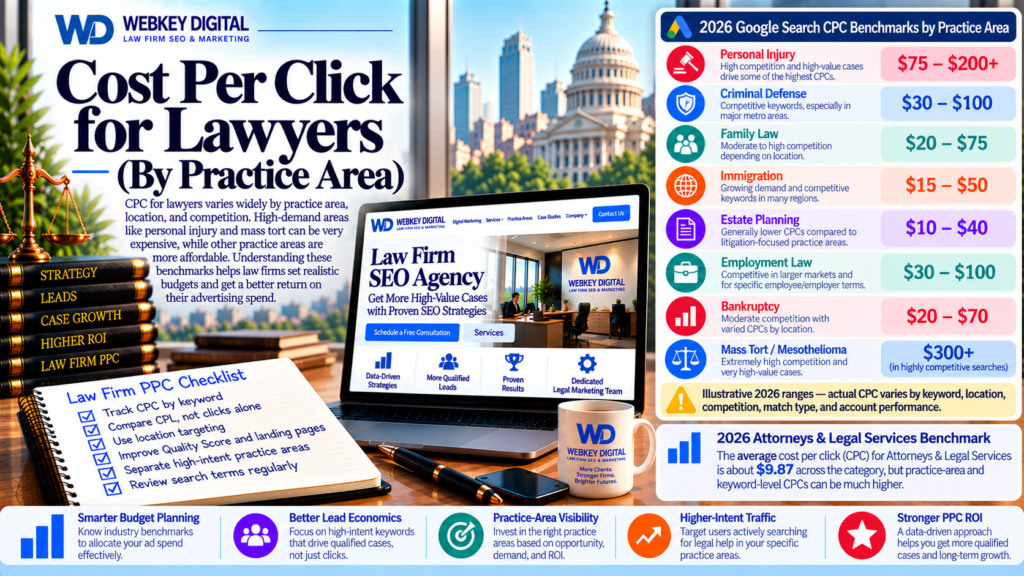
Cost per click for lawyers by practice area

Cost Per Click for Lawyers (By Practice Area)

Cost per click for lawyers varies significantly by practice area, keyword, location, competition, and campaign strategy. Explore 2026 CPC planning ranges for personal injury, DUI, family law, workers’ compensation, bankruptcy, immigration, estate planning, mass torts, and other legal services, plus how CPC connects to CPL, qualified leads, signed cases, and PPC ROI.

Learn more
Contact us

Let’s Build Your Law Firm’s Digital Authority

Looking to improve your law firm’s online visibility, get more qualified leads, or dominate Google search results in your practice area?

Your benefits:
What happens next?
1

We Schedule a call at your convenience 

2

We do a discovery and consulting meting 

3

We prepare a proposal 

Schedule a Free Consultation