Ethical PPC for Lawyers: How to Run Compliant Paid Search Campaigns

Ethical PPC for lawyers means using paid search advertising to attract potential clients without making misleading claims, creating unjustified expectations, improperly paying for referrals, or allowing a marketing vendor to violate professional responsibility rules on the firm’s behalf.

Pay-per-click advertising can put a law firm’s services in front of people actively searching for legal help. Google Ads, Microsoft Advertising, paid local campaigns, call ads, and other digital advertising channels can all be useful parts of a firm’s marketing strategy.

But legal PPC is different from ordinary commercial advertising. A campaign has to work within the professional obligations that apply to lawyer advertising, while also following the requirements of the jurisdictions in which the firm markets its services.

The goal is not to make PPC less competitive. It is to build campaigns that are both effective and professionally responsible.

What Does Ethical PPC Mean for Lawyers?

Ethical PPC starts with a simple principle: a law firm’s advertising should give prospective clients an accurate understanding of the firm and its services.

That applies to more than the headline of the ad.

A useful way to evaluate a campaign is to look at the entire client journey:

Search query → advertisement → landing page → contact form or call → intake process

An ad can be accurate while the landing page creates a misleading impression. A well-written landing page cannot necessarily fix a problematic advertisement either.

Ethical PPC therefore requires reviewing the campaign as a complete system.

The Legal Rules Behind Ethical PPC

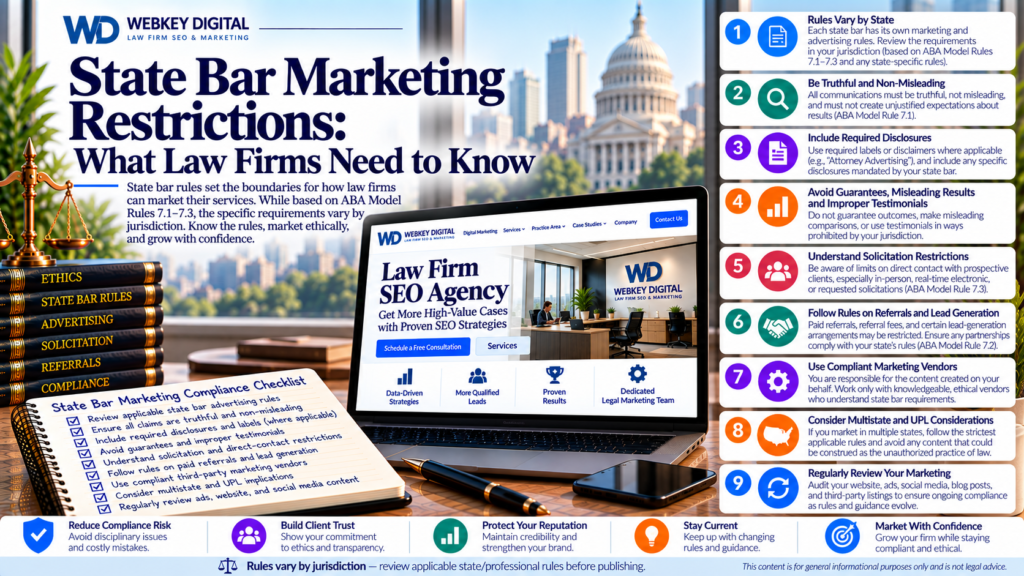
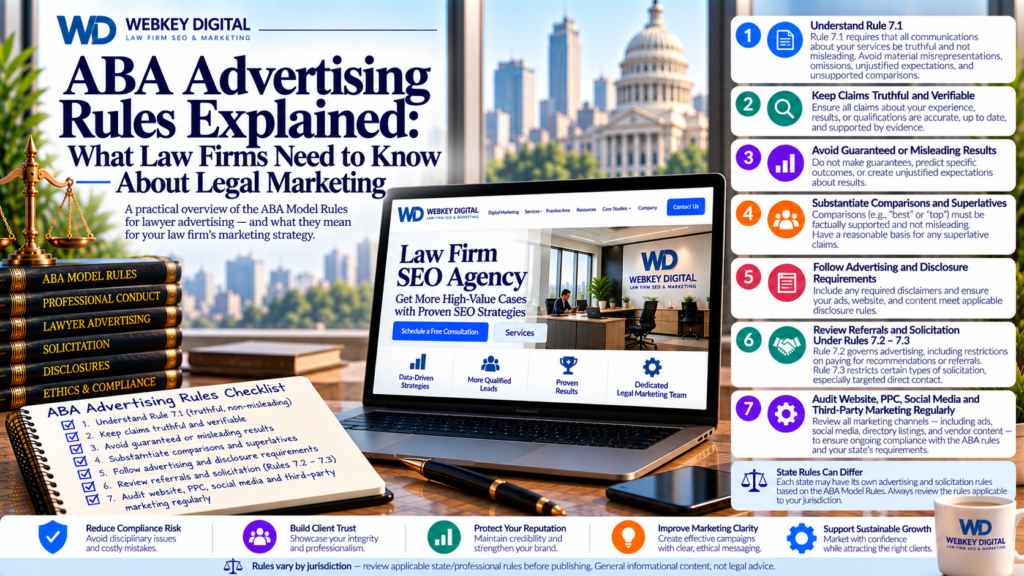
The ABA Model Rules provide a useful framework, although individual states can impose additional or different requirements.

Rule 7.1 requires communications about a lawyer’s services to be truthful and not misleading. The rule also addresses situations where technically truthful statements can become misleading because important context is omitted or the overall presentation creates an unsupported conclusion.

Rule 7.2 permits lawyers to advertise through various media and allows payment for reasonable advertising costs. It also restricts payments for recommendations while allowing certain Internet-based lead-generation arrangements when the applicable requirements are satisfied.

Rule 7.3 addresses solicitation, which is different from general advertising directed at the public. A PPC campaign aimed broadly at people searching for legal services is therefore different from targeted direct outreach to a specific prospective client.

These rules provide the foundation. The practical question is how to apply them to the actual campaign.

Start With Accurate PPC Ad Copy

A legal PPC ad should accurately represent:

  • The firm’s identity
  • Services offered
  • Jurisdictions served
  • Attorney qualifications
  • Consultation terms
  • Advertised fees
  • Case results, if mentioned
  • Material limitations

Avoid writing ads around whatever sounds most impressive.

Write them around claims the firm can support.

For example, instead of:

“The #1 Personal Injury Lawyers”

a firm could use:

“Personal Injury Attorneys Serving [Location]”

The second statement may be less aggressive, but it communicates the firm’s service without creating a questionable ranking claim.

Be Careful With “Best,” “Top,” and Similar Claims

PPC platforms encourage concise, attention-grabbing copy.

That can tempt marketers to use phrases such as:

  • Best
  • Top
  • Leading
  • Premier
  • No. 1
  • Most trusted
  • Most experienced
  • Award-winning
  • Expert

The question is not simply whether one of these words appears in an advertisement.

The important question is:

What factual basis supports the claim?

If the firm cannot clearly substantiate a comparative or superiority claim, there may be a better way to communicate the firm’s strengths.

Specific achievements, credentials, experience, locations, and services are often easier for prospective clients to understand than unsupported superlatives.

“Expert” and “Specialist” Claims

Terms describing specialization deserve additional review.

The ABA’s Rule 7.2 specifically addresses statements or implications that a lawyer is certified as a specialist. When certification is claimed under the Model Rule, the applicable certification and certifying organization must be properly identified.

That makes phrases such as these worth reviewing carefully:

  • Certified specialist
  • Board-certified attorney
  • Certified expert
  • Specialist in [practice area]

A PPC agency should never add these terms simply because they appear to be effective keywords.

Case Results in PPC Ads

Case results can demonstrate experience, but they can also create unrealistic expectations if presented without sufficient context.

Consider an advertisement stating:

“We Recovered $5 Million for Clients.”

A prospective client may immediately wonder:

  • Was this one case or multiple cases?
  • Was the result a settlement or verdict?
  • What type of matter was involved?
  • Were there unusual circumstances?
  • Is the result representative?
  • Does the firm handle similar cases?

The ABA commentary specifically warns that even truthful reports of achievements can become misleading when presented in a way that leads people to expect similar outcomes without considering the specific circumstances of their case.

If results are used in PPC, the landing page should provide enough context and any disclosures required by the relevant jurisdiction.

Testimonials in Paid Advertising

Testimonials can be effective, but they should be treated as advertising claims rather than casual website comments.

Before using a testimonial in PPC, consider whether it:

  • Is genuine
  • Has been authorized for advertising
  • Accurately reflects the client’s experience
  • Discusses a specific result
  • Could create an expectation about future outcomes
  • Requires additional disclosure
  • Complies with the applicable jurisdiction’s advertising rules

A short testimonial can carry a much stronger impression than a firm’s general description of its services, so context matters.

Attorney Advertising Disclosures

Some jurisdictions require specific disclosures in lawyer advertising, and the requirements are not uniform.

Rather than assuming that one disclosure works everywhere, multi-state firms should maintain a simple jurisdictional compliance matrix.

Jurisdiction

Advertising disclosure

Results rules

Testimonial rules

Filing/preapproval

Special requirements

State A

Review

Review

Review

Review

Review

State B

Review

Review

Review

Review

Review

State C

Review

Review

Review

Review

Review


Jurisdiction Advertising Disclosure Results Rules Testimonial Rules Filing/Preapproval Special Requirements
State A Review Review Review Review Review
State B Review Review Review Review Review
State C Review Review Review Review Review

The actual requirements should be verified against the rules applicable to the firm and the lawyers involved.

PPC Landing Pages Matter as Much as Ads

An ad is only the first step.

The landing page should support the promise made in the advertisement.

For example, if an ad says:

“Free Consultation With a Personal Injury Lawyer”

the landing page should clearly explain what the consultation includes.

If an ad says:

“No Fee Unless We Win”

the firm’s actual fee arrangement should be accurately explained, including material conditions that affect the offer.

Avoid a situation where the ad makes a simple promise and the important qualifications appear only after a visitor submits their information.

Geographic Targeting and Jurisdiction

Legal services are inherently geographic, so PPC campaigns should accurately represent where the firm practices.

Review:

  • Attorney licensing jurisdictions
  • Office locations
  • Actual service areas
  • Federal court admissions where relevant
  • Geographic targeting settings
  • Location-specific landing pages

Targeting a city through Google Ads does not automatically mean the firm has an office in that city.

Similarly, a statewide campaign should not imply a physical presence that does not exist.

Keyword Strategy and Misleading Search Intent

Keywords can influence the type of audience a law firm reaches.

The concern is not simply which keywords generate clicks. It is whether the resulting advertisement creates confusion about the firm’s identity or relationship to another organization.

Be particularly careful with searches involving:

  • Government agencies
  • Courts
  • Bar associations
  • Legal aid organizations
  • Official programs
  • Competitor firms
  • Individual attorneys

For example, an advertisement triggered by a search for a state bar’s lawyer referral service should not make the searcher believe the advertisement comes from or is endorsed by the bar.

The firm’s identity should remain clear.

Competitor and Conquest Keywords

Some firms use competitor names as PPC keywords.

The commercial strategy and the advertising copy should be evaluated separately.

There is a difference between:

Targeting a search containing a competitor’s name

and

Claiming an affiliation with that competitor.

A firm should not imply that it is:

  • The competitor
  • Associated with the competitor
  • Recommended by the competitor
  • Endorsed by the competitor
  • An official alternative to the competitor

The safest approach is straightforward identification of the actual advertiser.

Paying for Leads vs. Paying for Recommendations

Lead generation deserves a separate review because the payment structure can matter.

Under ABA Rule 7.2, paying reasonable advertising costs is permitted, while paying someone for recommending a lawyer’s services is generally restricted. The rule’s commentary also permits certain Internet-based lead-generation arrangements when the lead generator does not recommend the lawyer and the arrangement satisfies the other applicable requirements.

Before signing a lead-generation agreement, a firm should ask:

  • How are leads generated?
  • Does the provider recommend specific lawyers?
  • Does the provider claim to find the “best” attorney?
  • Does it evaluate a person’s legal problem before assigning the lead?
  • Is the firm listed alongside other lawyers?
  • How is the provider compensated?
  • What information is collected?
  • How is that information transferred?

The firm should understand exactly what it is paying for.

Working With PPC Agencies and Marketing Vendors

Hiring an agency does not mean the agency becomes responsible for the firm’s professional obligations.

The ABA’s digital advertising guidance specifically discusses the use of third-party marketing agencies and notes that lawyers have supervisory responsibilities concerning nonlawyer vendors.

A law firm should give its PPC agency clear instructions covering:

  • Approved claims
  • Prohibited language
  • Attorney credentials
  • Case results
  • Testimonials
  • Fee statements
  • Geographic restrictions
  • Required disclosures
  • Approval procedures
  • Recordkeeping

The agency should know which claims require attorney review before publication.

Create a Simple Ad Approval Workflow

A practical workflow can reduce unnecessary risk without slowing down every campaign change.

Step 1: Draft

The marketing team prepares:

  • Keywords
  • Headlines
  • Descriptions
  • Extensions
  • Landing pages
  • Call ads
  • Lead forms

Step 2: Compliance review

Review claims that involve legal qualifications, results, fees, comparisons, testimonials, or other potentially sensitive statements.

Step 3: Attorney approval

Have an appropriate attorney or designated reviewer approve material claims before publication.

Step 4: Launch

Publish only approved versions.

Step 5: Monitor

Review new platform-generated variations, landing-page changes, automated recommendations, and campaign expansions.

This final step matters because PPC platforms increasingly use automation.

AI-Generated PPC Copy Requires Human Review

AI can produce dozens of PPC variations quickly.

It can also generate claims that were never approved by the firm.

For example, an AI tool might produce:

  • “Best lawyer in the city”
  • “Guaranteed results”
  • “Top-rated specialist”
  • “Millions recovered”
  • “Free legal advice”
  • “No-risk representation”

without knowing whether those claims are accurate.

AI-generated copy should therefore go through the same review process as any other advertising copy.

The technology can accelerate drafting. It should not replace professional judgment.

Call Ads and Lead Forms

PPC campaigns increasingly use phone-call ads and platform-generated lead forms.

These should be reviewed as part of the firm’s intake process.

Consider:

  • What information is requested
  • What disclosure appears before submission
  • Whether sensitive information is requested
  • Where submissions are stored
  • Who receives them
  • How quickly leads are contacted
  • Whether calls are recorded
  • Whether automated systems answer calls
  • Whether the caller is speaking with an attorney or intake professional

The campaign should accurately describe the experience a prospective client receives after clicking or calling.

Retargeting and Privacy

Retargeting can help law firms reconnect with previous website visitors.

However, legal websites can involve highly sensitive subjects. A person researching divorce, criminal defense, bankruptcy, domestic violence, or another personal legal issue may not expect advertisements revealing that interest to appear later on a shared device.

Firms should therefore review their tracking technologies, advertising audiences, data practices, and applicable privacy requirements.

PPC performance should never be evaluated separately from how visitor information is handled.

Measure Qualified Leads, Not Just Clicks

Ethical PPC does not mean sacrificing performance.

A strong campaign can measure:

  • Click-through rate
  • Conversion rate
  • Cost per lead
  • Qualified lead rate
  • Consultation rate
  • Retained-client rate
  • Cost per retained matter
  • Revenue by campaign
  • Lead quality by practice area
  • Missed-call rate

A campaign generating 100 irrelevant leads may be less valuable than one generating 20 qualified consultations.

For law firms, optimizing for qualified business outcomes is generally more useful than maximizing raw lead volume.

Keep a PPC Compliance Record

Firms should consider maintaining records of:

  • Ad versions
  • Landing-page versions
  • Approval dates
  • Campaign dates
  • Advertised results
  • Testimonials
  • Disclosures
  • Attorney approvals
  • Agency instructions
  • Geographic targeting
  • Fee claims
  • Certification claims

Specific recordkeeping obligations can vary by jurisdiction, so firms should verify what applies to them.

Even when a particular record is not expressly required, documenting the approval process can make future campaign reviews much easier.

Common Ethical PPC Mistakes

1. Using unsupported superlatives

Claims such as “best” or “No. 1” can create unnecessary risk when they lack a clear factual basis.

2. Promising outcomes

Legal outcomes depend on facts, law, evidence, opposing parties, and other circumstances.

3. Hiding important qualifications

Material limitations should not be buried where a visitor is unlikely to see them.

4. Copying competitor advertisements

Another firm’s PPC copy is not a reliable compliance template.

5. Letting an agency publish without oversight

Marketing vendors should understand the firm’s advertising requirements and approval process.

6. Paying for improper recommendations

Advertising costs and payments for recommendations are not necessarily the same thing.

7. Ignoring landing pages

A strong advertisement can still lead visitors to a problematic page.

8. Misrepresenting geographic presence

Do not imply offices, attorneys, or service availability where they do not exist.

9. Allowing AI to publish automatically

Automated copy should be reviewed before it becomes public advertising.

10. Optimizing only for lead volume

More leads do not automatically mean better leads.

Ethical PPC Checklist for Law Firms

Advertising claims

  • Are claims truthful and supportable?
  • Are comparative claims substantiated?
  • Are attorney qualifications represented accurately?
  • Are results presented with appropriate context?

Compliance

  • Have applicable state advertising rules been reviewed?
  • Are specialization claims accurate?
  • Are required advertising disclosures included?
  • Is an appropriate attorney or firm identified as responsible for the communication?

Lead generation

  • Does the provider generate leads rather than improperly recommend the lawyer?
  • Is the payment arrangement permissible?
  • Has the firm reviewed the provider’s marketing language?

Landing pages

  • Does the landing page support the ad?
  • Are fee claims clear?
  • Are results and testimonials appropriately presented?
  • Are geographic limitations clear where relevant?

Technology

  • Has AI-generated copy been reviewed?
  • Are automated ad variations monitored?
  • Are call and tracking practices reviewed?
  • Are lead forms appropriately designed?

Internal process

  • Is there an approval workflow?
  • Are approved claims documented?
  • Are marketing vendors given clear instructions?
  • Are campaign records maintained?

Frequently Asked Questions

Is PPC advertising ethical for lawyers?

Yes. PPC can be a legitimate form of lawyer advertising when the campaign complies with applicable professional responsibility and advertising requirements.

Can lawyers pay for online leads?

Certain Internet-based lead-generation arrangements are permitted under the ABA Model Rules, provided the arrangement meets the applicable requirements and does not improperly involve a recommendation or referral payment. State rules may differ.

Can a law firm hire a PPC agency?

Yes. A law firm can use an outside PPC agency, but the firm should maintain appropriate oversight of the agency’s advertising and lead-generation activities.

Can lawyers advertise case results on Google?

Potentially. The firm should review how results are presented and whether additional disclosures are required in the applicable jurisdiction. Results should not be presented in a way that creates an unjustified expectation about what another client will achieve.

Can lawyers use “best” in PPC ads?

There is no universal answer. The firm should determine whether the claim is truthful, supportable, and compliant with the applicable jurisdiction’s rules before using it.

Can AI write PPC ads for a law firm?

AI can assist with drafting, but the resulting copy should be reviewed for accuracy, compliance, and unsupported claims before publication.

Is Google Ads considered solicitation?

General public advertising is different from targeted solicitation. Whether a particular campaign qualifies as solicitation depends on how the communication is directed and the circumstances involved.

Do PPC rules differ by state?

Yes. The ABA Model Rules provide a framework, but individual jurisdictions can impose additional requirements.

Final Takeaway

Ethical PPC for lawyers is not about making paid search campaigns less competitive. It is about building campaigns that generate qualified opportunities without compromising accuracy, professional responsibility, or client trust.

The strongest campaigns connect:

Accurate ad copy + relevant landing pages + compliant lead generation + responsible vendor oversight + appropriate targeting + ongoing review

PPC can be an effective client-acquisition channel for law firms when these pieces work together.

Before launching or significantly changing a campaign, firms should review the advertising requirements applicable to each jurisdiction in which they market legal services and establish an approval process that keeps attorneys, marketing teams, agencies, and technology providers aligned.

The objective is not simply more clicks.

It is qualified visibility without sacrificing professional integrity.
Ethical PPC for Lawyers: How to Run Compliant Paid Search Campaigns

Ethical PPC for lawyers means using paid search advertising to attract potential clients without making misleading claims, creating unjustified expectations, improperly paying for referrals, or allowing a marketing vendor to violate professional responsibility rules on the firm’s behalf.

Pay-per-click advertising can put a law firm’s services in front of people actively searching for legal help. Google Ads, Microsoft Advertising, paid local campaigns, call ads, and other digital advertising channels can all be useful parts of a firm’s marketing strategy.

But legal PPC is different from ordinary commercial advertising. A campaign has to work within the professional obligations that apply to lawyer advertising, while also following the requirements of the jurisdictions in which the firm markets its services.

The goal is not to make PPC less competitive. It is to build campaigns that are both effective and professionally responsible.

What Does Ethical PPC Mean for Lawyers?

Ethical PPC starts with a simple principle: a law firm’s advertising should give prospective clients an accurate understanding of the firm and its services.

That applies to more than the headline of the ad.

A useful way to evaluate a campaign is to look at the entire client journey:

Search query → advertisement → landing page → contact form or call → intake process

An ad can be accurate while the landing page creates a misleading impression. A well-written landing page cannot necessarily fix a problematic advertisement either.

Ethical PPC therefore requires reviewing the campaign as a complete system.

The Legal Rules Behind Ethical PPC

The ABA Model Rules provide a useful framework, although individual states can impose additional or different requirements.

Rule 7.1 requires communications about a lawyer’s services to be truthful and not misleading. The rule also addresses situations where technically truthful statements can become misleading because important context is omitted or the overall presentation creates an unsupported conclusion.

Rule 7.2 permits lawyers to advertise through various media and allows payment for reasonable advertising costs. It also restricts payments for recommendations while allowing certain Internet-based lead-generation arrangements when the applicable requirements are satisfied.

Rule 7.3 addresses solicitation, which is different from general advertising directed at the public. A PPC campaign aimed broadly at people searching for legal services is therefore different from targeted direct outreach to a specific prospective client.

These rules provide the foundation. The practical question is how to apply them to the actual campaign.

Start With Accurate PPC Ad Copy

A legal PPC ad should accurately represent:

  • The firm’s identity
  • Services offered
  • Jurisdictions served
  • Attorney qualifications
  • Consultation terms
  • Advertised fees
  • Case results, if mentioned
  • Material limitations

Avoid writing ads around whatever sounds most impressive.

Write them around claims the firm can support.

For example, instead of:

“The #1 Personal Injury Lawyers”

a firm could use:

“Personal Injury Attorneys Serving [Location]”

The second statement may be less aggressive, but it communicates the firm’s service without creating a questionable ranking claim.

Be Careful With “Best,” “Top,” and Similar Claims

PPC platforms encourage concise, attention-grabbing copy.

That can tempt marketers to use phrases such as:

  • Best
  • Top
  • Leading
  • Premier
  • No. 1
  • Most trusted
  • Most experienced
  • Award-winning
  • Expert

The question is not simply whether one of these words appears in an advertisement.

The important question is:

What factual basis supports the claim?

If the firm cannot clearly substantiate a comparative or superiority claim, there may be a better way to communicate the firm’s strengths.

Specific achievements, credentials, experience, locations, and services are often easier for prospective clients to understand than unsupported superlatives.

“Expert” and “Specialist” Claims

Terms describing specialization deserve additional review.

The ABA’s Rule 7.2 specifically addresses statements or implications that a lawyer is certified as a specialist. When certification is claimed under the Model Rule, the applicable certification and certifying organization must be properly identified.

That makes phrases such as these worth reviewing carefully:

  • Certified specialist
  • Board-certified attorney
  • Certified expert
  • Specialist in [practice area]

A PPC agency should never add these terms simply because they appear to be effective keywords.

Case Results in PPC Ads

Case results can demonstrate experience, but they can also create unrealistic expectations if presented without sufficient context.

Consider an advertisement stating:

“We Recovered $5 Million for Clients.”

A prospective client may immediately wonder:

  • Was this one case or multiple cases?
  • Was the result a settlement or verdict?
  • What type of matter was involved?
  • Were there unusual circumstances?
  • Is the result representative?
  • Does the firm handle similar cases?

The ABA commentary specifically warns that even truthful reports of achievements can become misleading when presented in a way that leads people to expect similar outcomes without considering the specific circumstances of their case.

If results are used in PPC, the landing page should provide enough context and any disclosures required by the relevant jurisdiction.

Testimonials in Paid Advertising

Testimonials can be effective, but they should be treated as advertising claims rather than casual website comments.

Before using a testimonial in PPC, consider whether it:

  • Is genuine
  • Has been authorized for advertising
  • Accurately reflects the client’s experience
  • Discusses a specific result
  • Could create an expectation about future outcomes
  • Requires additional disclosure
  • Complies with the applicable jurisdiction’s advertising rules

A short testimonial can carry a much stronger impression than a firm’s general description of its services, so context matters.

Attorney Advertising Disclosures

Some jurisdictions require specific disclosures in lawyer advertising, and the requirements are not uniform.

Rather than assuming that one disclosure works everywhere, multi-state firms should maintain a simple jurisdictional compliance matrix.

Jurisdiction

Advertising disclosure

Results rules

Testimonial rules

Filing/preapproval

Special requirements

State A

Review

Review

Review

Review

Review

State B

Review

Review

Review

Review

Review

State C

Review

Review

Review

Review

Review


Jurisdiction Advertising Disclosure Results Rules Testimonial Rules Filing/Preapproval Special Requirements
State A Review Review Review Review Review
State B Review Review Review Review Review
State C Review Review Review Review Review

The actual requirements should be verified against the rules applicable to the firm and the lawyers involved.

PPC Landing Pages Matter as Much as Ads

An ad is only the first step.

The landing page should support the promise made in the advertisement.

For example, if an ad says:

“Free Consultation With a Personal Injury Lawyer”

the landing page should clearly explain what the consultation includes.

If an ad says:

“No Fee Unless We Win”

the firm’s actual fee arrangement should be accurately explained, including material conditions that affect the offer.

Avoid a situation where the ad makes a simple promise and the important qualifications appear only after a visitor submits their information.

Geographic Targeting and Jurisdiction

Legal services are inherently geographic, so PPC campaigns should accurately represent where the firm practices.

Review:

  • Attorney licensing jurisdictions
  • Office locations
  • Actual service areas
  • Federal court admissions where relevant
  • Geographic targeting settings
  • Location-specific landing pages

Targeting a city through Google Ads does not automatically mean the firm has an office in that city.

Similarly, a statewide campaign should not imply a physical presence that does not exist.

Keyword Strategy and Misleading Search Intent

Keywords can influence the type of audience a law firm reaches.

The concern is not simply which keywords generate clicks. It is whether the resulting advertisement creates confusion about the firm’s identity or relationship to another organization.

Be particularly careful with searches involving:

  • Government agencies
  • Courts
  • Bar associations
  • Legal aid organizations
  • Official programs
  • Competitor firms
  • Individual attorneys

For example, an advertisement triggered by a search for a state bar’s lawyer referral service should not make the searcher believe the advertisement comes from or is endorsed by the bar.

The firm’s identity should remain clear.

Competitor and Conquest Keywords

Some firms use competitor names as PPC keywords.

The commercial strategy and the advertising copy should be evaluated separately.

There is a difference between:

Targeting a search containing a competitor’s name

and

Claiming an affiliation with that competitor.

A firm should not imply that it is:

  • The competitor
  • Associated with the competitor
  • Recommended by the competitor
  • Endorsed by the competitor
  • An official alternative to the competitor

The safest approach is straightforward identification of the actual advertiser.

Paying for Leads vs. Paying for Recommendations

Lead generation deserves a separate review because the payment structure can matter.

Under ABA Rule 7.2, paying reasonable advertising costs is permitted, while paying someone for recommending a lawyer’s services is generally restricted. The rule’s commentary also permits certain Internet-based lead-generation arrangements when the lead generator does not recommend the lawyer and the arrangement satisfies the other applicable requirements.

Before signing a lead-generation agreement, a firm should ask:

  • How are leads generated?
  • Does the provider recommend specific lawyers?
  • Does the provider claim to find the “best” attorney?
  • Does it evaluate a person’s legal problem before assigning the lead?
  • Is the firm listed alongside other lawyers?
  • How is the provider compensated?
  • What information is collected?
  • How is that information transferred?

The firm should understand exactly what it is paying for.

Working With PPC Agencies and Marketing Vendors

Hiring an agency does not mean the agency becomes responsible for the firm’s professional obligations.

The ABA’s digital advertising guidance specifically discusses the use of third-party marketing agencies and notes that lawyers have supervisory responsibilities concerning nonlawyer vendors.

A law firm should give its PPC agency clear instructions covering:

  • Approved claims
  • Prohibited language
  • Attorney credentials
  • Case results
  • Testimonials
  • Fee statements
  • Geographic restrictions
  • Required disclosures
  • Approval procedures
  • Recordkeeping

The agency should know which claims require attorney review before publication.

Create a Simple Ad Approval Workflow

A practical workflow can reduce unnecessary risk without slowing down every campaign change.

Step 1: Draft

The marketing team prepares:

  • Keywords
  • Headlines
  • Descriptions
  • Extensions
  • Landing pages
  • Call ads
  • Lead forms

Step 2: Compliance review

Review claims that involve legal qualifications, results, fees, comparisons, testimonials, or other potentially sensitive statements.

Step 3: Attorney approval

Have an appropriate attorney or designated reviewer approve material claims before publication.

Step 4: Launch

Publish only approved versions.

Step 5: Monitor

Review new platform-generated variations, landing-page changes, automated recommendations, and campaign expansions.

This final step matters because PPC platforms increasingly use automation.

AI-Generated PPC Copy Requires Human Review

AI can produce dozens of PPC variations quickly.

It can also generate claims that were never approved by the firm.

For example, an AI tool might produce:

  • “Best lawyer in the city”
  • “Guaranteed results”
  • “Top-rated specialist”
  • “Millions recovered”
  • “Free legal advice”
  • “No-risk representation”

without knowing whether those claims are accurate.

AI-generated copy should therefore go through the same review process as any other advertising copy.

The technology can accelerate drafting. It should not replace professional judgment.

Call Ads and Lead Forms

PPC campaigns increasingly use phone-call ads and platform-generated lead forms.

These should be reviewed as part of the firm’s intake process.

Consider:

  • What information is requested
  • What disclosure appears before submission
  • Whether sensitive information is requested
  • Where submissions are stored
  • Who receives them
  • How quickly leads are contacted
  • Whether calls are recorded
  • Whether automated systems answer calls
  • Whether the caller is speaking with an attorney or intake professional

The campaign should accurately describe the experience a prospective client receives after clicking or calling.

Retargeting and Privacy

Retargeting can help law firms reconnect with previous website visitors.

However, legal websites can involve highly sensitive subjects. A person researching divorce, criminal defense, bankruptcy, domestic violence, or another personal legal issue may not expect advertisements revealing that interest to appear later on a shared device.

Firms should therefore review their tracking technologies, advertising audiences, data practices, and applicable privacy requirements.

PPC performance should never be evaluated separately from how visitor information is handled.

Measure Qualified Leads, Not Just Clicks

Ethical PPC does not mean sacrificing performance.

A strong campaign can measure:

  • Click-through rate
  • Conversion rate
  • Cost per lead
  • Qualified lead rate
  • Consultation rate
  • Retained-client rate
  • Cost per retained matter
  • Revenue by campaign
  • Lead quality by practice area
  • Missed-call rate

A campaign generating 100 irrelevant leads may be less valuable than one generating 20 qualified consultations.

For law firms, optimizing for qualified business outcomes is generally more useful than maximizing raw lead volume.

Keep a PPC Compliance Record

Firms should consider maintaining records of:

  • Ad versions
  • Landing-page versions
  • Approval dates
  • Campaign dates
  • Advertised results
  • Testimonials
  • Disclosures
  • Attorney approvals
  • Agency instructions
  • Geographic targeting
  • Fee claims
  • Certification claims

Specific recordkeeping obligations can vary by jurisdiction, so firms should verify what applies to them.

Even when a particular record is not expressly required, documenting the approval process can make future campaign reviews much easier.

Common Ethical PPC Mistakes

1. Using unsupported superlatives

Claims such as “best” or “No. 1” can create unnecessary risk when they lack a clear factual basis.

2. Promising outcomes

Legal outcomes depend on facts, law, evidence, opposing parties, and other circumstances.

3. Hiding important qualifications

Material limitations should not be buried where a visitor is unlikely to see them.

4. Copying competitor advertisements

Another firm’s PPC copy is not a reliable compliance template.

5. Letting an agency publish without oversight

Marketing vendors should understand the firm’s advertising requirements and approval process.

6. Paying for improper recommendations

Advertising costs and payments for recommendations are not necessarily the same thing.

7. Ignoring landing pages

A strong advertisement can still lead visitors to a problematic page.

8. Misrepresenting geographic presence

Do not imply offices, attorneys, or service availability where they do not exist.

9. Allowing AI to publish automatically

Automated copy should be reviewed before it becomes public advertising.

10. Optimizing only for lead volume

More leads do not automatically mean better leads.

Ethical PPC Checklist for Law Firms

Advertising claims

  • Are claims truthful and supportable?
  • Are comparative claims substantiated?
  • Are attorney qualifications represented accurately?
  • Are results presented with appropriate context?

Compliance

  • Have applicable state advertising rules been reviewed?
  • Are specialization claims accurate?
  • Are required advertising disclosures included?
  • Is an appropriate attorney or firm identified as responsible for the communication?

Lead generation

  • Does the provider generate leads rather than improperly recommend the lawyer?
  • Is the payment arrangement permissible?
  • Has the firm reviewed the provider’s marketing language?

Landing pages

  • Does the landing page support the ad?
  • Are fee claims clear?
  • Are results and testimonials appropriately presented?
  • Are geographic limitations clear where relevant?

Technology

  • Has AI-generated copy been reviewed?
  • Are automated ad variations monitored?
  • Are call and tracking practices reviewed?
  • Are lead forms appropriately designed?

Internal process

  • Is there an approval workflow?
  • Are approved claims documented?
  • Are marketing vendors given clear instructions?
  • Are campaign records maintained?

Frequently Asked Questions

Is PPC advertising ethical for lawyers?

Yes. PPC can be a legitimate form of lawyer advertising when the campaign complies with applicable professional responsibility and advertising requirements.

Can lawyers pay for online leads?

Certain Internet-based lead-generation arrangements are permitted under the ABA Model Rules, provided the arrangement meets the applicable requirements and does not improperly involve a recommendation or referral payment. State rules may differ.

Can a law firm hire a PPC agency?

Yes. A law firm can use an outside PPC agency, but the firm should maintain appropriate oversight of the agency’s advertising and lead-generation activities.

Can lawyers advertise case results on Google?

Potentially. The firm should review how results are presented and whether additional disclosures are required in the applicable jurisdiction. Results should not be presented in a way that creates an unjustified expectation about what another client will achieve.

Can lawyers use “best” in PPC ads?

There is no universal answer. The firm should determine whether the claim is truthful, supportable, and compliant with the applicable jurisdiction’s rules before using it.

Can AI write PPC ads for a law firm?

AI can assist with drafting, but the resulting copy should be reviewed for accuracy, compliance, and unsupported claims before publication.

Is Google Ads considered solicitation?

General public advertising is different from targeted solicitation. Whether a particular campaign qualifies as solicitation depends on how the communication is directed and the circumstances involved.

Do PPC rules differ by state?

Yes. The ABA Model Rules provide a framework, but individual jurisdictions can impose additional requirements.

Final Takeaway

Ethical PPC for lawyers is not about making paid search campaigns less competitive. It is about building campaigns that generate qualified opportunities without compromising accuracy, professional responsibility, or client trust.

The strongest campaigns connect:

Accurate ad copy + relevant landing pages + compliant lead generation + responsible vendor oversight + appropriate targeting + ongoing review

PPC can be an effective client-acquisition channel for law firms when these pieces work together.

Before launching or significantly changing a campaign, firms should review the advertising requirements applicable to each jurisdiction in which they market legal services and establish an approval process that keeps attorneys, marketing teams, agencies, and technology providers aligned.

The objective is not simply more clicks.

It is qualified visibility without sacrificing professional integrity.

case studies

See More Case Studies

Contact us

Let’s Build Your Law Firm’s Digital Authority

Looking to improve your law firm’s online visibility, get more qualified leads, or dominate Google search results in your practice area?

Your benefits:
What happens next?
1

We Schedule a call at your convenience 

2

We do a discovery and consulting meting 

3

We prepare a proposal 

Schedule a Free Consultation