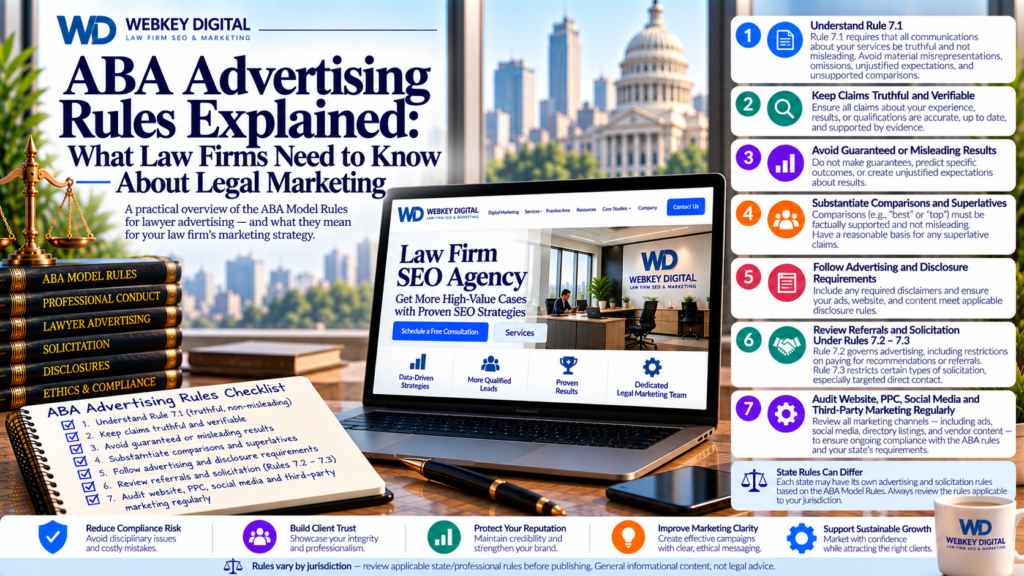
State Bar Marketing Restrictions: What Law Firms Need to Know

State bar marketing restrictions can significantly affect how a law firm promotes its services online and offline. Although the ABA Model Rules provide an important national framework, individual states and jurisdictions can adopt their own attorney advertising rules, disclosure requirements, solicitation restrictions, filing procedures, and limitations on specific marketing claims.

For law firms, this creates an important practical issue: a marketing strategy that is acceptable in one jurisdiction may require different disclosures, review procedures, or wording in another.

That matters even more in digital marketing.

A law firm’s website can reach people across the country. Google Ads can be displayed to users in different jurisdictions. Social media posts can be viewed anywhere. SEO content can attract visitors from states where the firm’s attorneys do not practice.

As a result, legal marketing compliance should be considered during strategy, content creation, publication, and campaign management—not after an advertisement has already gone live.

Why State Bar Marketing Rules Matter

State bar marketing rules exist to regulate how lawyers communicate about their services and, among other things, to protect the public from misleading or deceptive communications.

The ABA Model Rules provide a starting point, but the actual rules governing a lawyer depend on the applicable jurisdiction.

That distinction is important because states can differ on issues such as:

  • What qualifies as attorney advertising
  • Required disclaimers
  • Testimonials
  • Case results
  • Comparative claims
  • Specialization statements
  • Firm names
  • Solicitation
  • Direct mail
  • Email marketing
  • Search advertising
  • Lead-generation arrangements
  • Advertising filing requirements
  • Recordkeeping
  • Approval procedures

The differences can be substantial.

For example, Alabama’s advertising rules were significantly amended effective January 1, 2026. The changes address issues including disclaimer presentation, testimonials, Internet search terms, advertised results, and targeted communications.

Texas provides another example of a more formal advertising-review structure. The State Bar of Texas explains that many public marketing efforts must be submitted to its Advertising Review Committee, although exemptions exist.

The lesson is simple:

Do not assume that compliance with the ABA Model Rules automatically means compliance with every state bar’s rules.

ABA Model Rules vs. State Bar Rules

The ABA Model Rules are model rules.

They provide a framework that jurisdictions may adopt, modify, supplement, or interpret differently.

State professional-conduct rules are what lawyers must actually follow in the jurisdictions where they are licensed and practicing.

This distinction is particularly important for marketing agencies.

An SEO agency may understand Google’s policies and digital marketing best practices without understanding the professional-conduct rules governing attorney advertising.

The law firm remains responsible for the marketing it publishes.

The ABA has specifically noted that firms can remain responsible for compliance when outside entities participate in digital marketing activities on their behalf.

What Counts as Attorney Marketing?

State rules differ, but marketing can encompass far more than a traditional television or newspaper advertisement.

Potentially relevant communications can include:

  • Law firm websites
  • Practice-area pages
  • Attorney biographies
  • Blog articles
  • FAQs
  • Google Ads
  • Local service advertising
  • Social media
  • Videos
  • Podcasts
  • Email campaigns
  • Online directories
  • Review profiles
  • Testimonials
  • Press releases
  • Sponsorships
  • Direct mail
  • Lead-generation platforms
  • Referral services
  • Landing pages
  • Chatbots
  • Marketing emails
  • Digital banners

This is why a compliance process should cover the firm’s entire marketing ecosystem.

Why One National Marketing Template Can Be Risky

A law firm operating in several states may be tempted to create one website template and use the same advertising language everywhere.

That can create problems.

Suppose a firm has offices in:

  • Texas
  • Florida
  • New York
  • California

The firm might want one universal attorney bio, one set of disclaimers, one case-results page, and one PPC campaign.

But each jurisdiction may have different requirements.

A statement that works in one state may require modification elsewhere.

A disclaimer required in one jurisdiction may not be required in another.

A filing procedure may apply in one state while another state does not have the same process.

A multi-state strategy therefore needs a jurisdiction matrix, not simply a national template.

State-Specific Disclaimers

One of the most common areas of difference is disclaimer language.

Depending on the jurisdiction and type of communication, a law firm may need disclosures concerning:

  • Attorney advertising
  • Past results
  • No guarantee of outcome
  • General legal information
  • Certification
  • Geographic limitations
  • Responsible attorney or firm
  • Referral arrangements
  • Other required information

The exact requirements vary.

More importantly, disclaimers should be visible and understandable.

For example, Alabama’s 2026 rules state that required disclaimers must be legible and easy to see and read when written, and easy to understand and hear when spoken.

This illustrates why simply adding tiny disclaimer text to a website footer may not satisfy a particular state’s requirements.

Case Results and Settlement Advertising

Case results are one of the most sensitive areas of attorney marketing.

A law firm may want to highlight:

  • Verdicts
  • Settlements
  • Awards
  • Recoveries
  • Successful defenses
  • Significant outcomes

But state rules may impose specific requirements concerning how those results are presented.

Texas, for example, has specific rules concerning advertisements that describe large verdicts or settlements. Its State Bar guidance warns that marketing professionals may inadvertently create compliance problems when emphasizing results without understanding the applicable requirements.

A marketing team should therefore ask:

  • Is the result objectively verifiable?
  • Does the state require additional information?
  • Does the advertisement explain relevant circumstances?
  • Could the result create an unjustified expectation?
  • Does the jurisdiction require a disclaimer?
  • Is the result representative or unusual?
  • Is the wording accurate?

Never assume that a large settlement number is automatically safe to publish.

Testimonials and Client Reviews

Testimonials can create trust, but they also create advertising-compliance considerations.

State rules may address:

  • Whether testimonials are permitted
  • What disclosures are required
  • Whether compensation is involved
  • Whether the speaker has actual knowledge of the lawyer’s services
  • Whether the testimonial implies a guaranteed result
  • How past results are described

Alabama’s revised rules, for example, require testimonials used in advertisements to come from someone with actual knowledge and personal experience with the lawyer.

The firm should therefore maintain a process for verifying testimonials rather than copying reviews from one platform into every marketing channel without review.

“Best Lawyer” and Comparative Claims

Statements such as:

  • “Best lawyer in the city”
  • “Top personal injury firm”
  • “Leading criminal defense attorney”
  • “Number one law firm”
  • “More experienced than every competitor”

can create compliance concerns.

Some states require objective substantiation for comparative claims.

Texas, for example, has rules addressing comparisons between lawyers’ services and requires such comparisons to be supported by verifiable, objective data.

Even where a statement might appear harmless from a marketing perspective, the firm should ask:

Can we objectively substantiate exactly what this claim says?

If not, use more precise factual language.

For example:

Instead of:

We are the best personal injury lawyers in Dallas.

Consider:

Our attorneys represent clients in personal injury matters throughout the Dallas area.

The second statement communicates the firm’s service without making an unsupported superiority claim.

Specialization and Certification Claims

Law firms should also review statements involving:

  • Specialist
  • Certified specialist
  • Board certified
  • Expert
  • Authority
  • Leading attorney

State requirements can vary considerably.

A lawyer should not assume that substantial experience automatically permits the use of a formal specialization or certification designation.

If a state recognizes a particular certification, the firm’s marketing should accurately identify the certification and comply with applicable requirements.

Law Firm Names and Trade Names

Marketing compliance is not limited to advertising copy.

Some jurisdictions have specific requirements concerning:

  • Law firm names
  • Trade names
  • Office names
  • Domain names
  • Lawyer titles
  • Partnerships
  • Professional corporations

A firm expanding into a new state should review its name before launching a local website or office campaign.

This is particularly important for national law firms and firms using branded marketing names.

Website Compliance

A law firm’s website should be included in its advertising compliance review.

Review:

Homepage

Check:

  • Claims about the firm
  • Superlatives
  • Results
  • Awards
  • Practice-area statements
  • Geographic claims
  • Disclaimers

Practice-Area Pages

Check:

  • Legal claims
  • Outcome language
  • Guarantees
  • Attorney qualifications
  • Calls to action
  • Jurisdictional statements

Attorney Bios

Check:

  • Credentials
  • Experience
  • Awards
  • Certifications
  • Specialization claims
  • Bar admissions

Testimonials

Check:

  • Authenticity
  • Required disclosures
  • Outcome implications
  • State-specific requirements

Blog Content

Check:

  • Accuracy
  • Current law
  • Misleading claims
  • Individualized legal advice
  • Attorney-client relationship language where appropriate

A website is not exempt simply because it is primarily educational.

SEO Content and State Bar Rules

SEO creates an interesting compliance issue because content may be designed to rank for searches across multiple geographic markets.

For example:

Best Personal Injury Lawyer in Miami

might be used as a target keyword.

But the marketing team should not automatically turn the keyword into a headline claiming:

We Are the Best Personal Injury Lawyers in Miami.

Search volume does not justify an unsupported marketing claim.

SEO strategy should therefore distinguish between:

Search language

and

marketing claims.

A keyword can be targeted naturally without making a potentially misleading statement.

Local SEO and Attorney Advertising

Local SEO can involve:

  • Google Business Profiles
  • Legal directories
  • Local landing pages
  • Map listings
  • Reviews
  • Citations
  • Local service advertisements

Each should be reviewed for accuracy.

Pay attention to:

  • Firm name
  • Attorney names
  • Practice areas
  • Office locations
  • Service areas
  • Telephone numbers
  • Credentials
  • Reviews
  • Descriptions

Do not create a virtual impression that an attorney maintains an office in a location where the firm does not actually operate.

Google Ads and PPC Compliance

Paid search campaigns should go through the same compliance process as other advertising.

Review:

  • Headlines
  • Descriptions
  • Display URLs
  • Landing pages
  • Call extensions
  • Location targeting
  • Claims
  • Results
  • Testimonials
  • Specialization statements
  • Disclaimers

A PPC agency may focus on click-through rates and conversion rates.

The law firm must also focus on whether the communication complies with applicable professional rules.

Texas specifically warns that marketing companies working on search-engine marketing may not understand the advertising rules lawyers must follow.

That makes attorney or compliance review particularly important.

Social Media Marketing

Social media adds another layer because posts can be created quickly and often by multiple people.

Potentially regulated content can include:

  • Instagram posts
  • Facebook posts
  • LinkedIn updates
  • TikTok videos
  • YouTube videos
  • Threads
  • X posts
  • Attorney comments
  • Stories
  • Reels
  • Paid social advertising

A firm’s social media policy should define who can publish content and what requires review.

Avoid assuming that an informal caption is exempt because it does not look like a traditional advertisement.

AI Chatbots and Law Firm Marketing

AI-powered chatbots can create additional professional-responsibility concerns.

A chatbot may:

  • Collect contact information
  • Answer legal questions
  • Recommend a service
  • Describe the firm
  • Encourage someone to contact an attorney
  • Appear to provide legal advice

The ABA has noted that law firms using AI chatbots should review their scripts and address issues such as whether users might misunderstand the nature of the interaction or believe an attorney-client relationship has been created.

A firm should therefore establish clear boundaries around:

  • Legal advice
  • Confidential information
  • Intake
  • Conflict checks
  • Attorney-client relationship formation
  • Disclaimers
  • Escalation to human staff

AI-Generated Marketing Content

AI can help law firms produce:

  • Blog drafts
  • Social posts
  • Ad variations
  • Video scripts
  • FAQs
  • Email campaigns

But automated content does not eliminate the firm’s responsibility for what it publishes.

This is particularly important as states and courts increasingly address AI-related professional responsibilities.

For example, California lawmakers passed legislation in September 2026 concerning lawyers’ use of generative AI, including requirements related to accuracy verification and confidentiality; the legislation was awaiting the governor’s signature at the time of reporting.

The broader marketing lesson is that AI-generated claims should be reviewed before publication.

Direct Solicitation Rules

State restrictions can be particularly significant when marketing moves from general advertising to direct solicitation.

Potentially sensitive channels include:

  • Direct mail
  • Email
  • Text messages
  • Phone calls
  • Social media direct messages
  • In-person outreach

Rules can differ based on:

  • Who is contacted
  • Why they are contacted
  • Whether they are already a client
  • Whether the person has a known legal problem
  • The timing of the communication
  • The type of legal matter
  • Whether the communication is real-time

Alabama’s 2026 rules provide a useful illustration: they permit certain direct email or letter communications to people known to need legal services under specified circumstances while restricting certain real-time solicitation methods.

This is exactly why firms should avoid creating one nationwide solicitation template.

Advertising Filing and Preapproval Requirements

Another major difference between states involves whether advertisements must be filed with a state bar or advertising-review authority.

Some jurisdictions have formal filing or review processes.

Texas is a prominent example. The State Bar of Texas states that many public marketing efforts must be submitted to its Advertising Review Committee, although certain advertisements are exempt.

Texas also encourages attorneys to seek preapproval before disseminating advertisements or solicitation communications and explains that preapproval can provide compliance benefits.

This creates an important workflow consideration:

Do not schedule a campaign launch before determining whether the advertisement has a filing or approval requirement.

Recordkeeping Requirements

Some jurisdictions impose recordkeeping requirements for advertisements and marketing communications.

Depending on the state and type of communication, a firm may need to retain:

  • Copies of advertisements
  • Scripts
  • Versions of advertisements
  • Publication dates
  • Distribution information
  • Approval records
  • Supporting documentation
  • Testimonials
  • Substantiation for claims

A marketing team should not delete old versions simply because a campaign has ended if the applicable jurisdiction requires retention.

Build recordkeeping into the firm’s marketing workflow.

Multi-State Law Firm Marketing Strategy

A multi-state firm should create a state marketing compliance matrix.

For each jurisdiction, track:

Compliance Area State Requirement
Advertising definition What counts as an advertisement
Disclaimers Required wording/placement
Testimonials Restrictions
Case results Disclosure/substantiation
Specialization Certification requirements
Solicitation Permitted/restricted methods
Direct mail Required disclosures
Email Applicable restrictions
Social media Advertising treatment
PPC Specific requirements
Filing Whether filing is required
Preapproval Whether available/required
Recordkeeping Retention requirements
Firm name Restrictions
Referral arrangements Applicable rules
Responsible attorney Identification requirements

The matrix should be maintained by someone responsible for compliance and updated when state rules change.

Example: Why a National Campaign Can Need State-Level Changes

Imagine a national personal injury campaign using this headline:

We Get You Maximum Compensation

Before publishing it nationally, the firm should ask:

  • Is “maximum” objectively supportable?
  • Does the claim create an expectation of a particular result?
  • Does the state require specific disclosure language?
  • Does the landing page contain additional claims?
  • Does the campaign use testimonials?
  • Does the campaign target people immediately after an accident?
  • Does the state have specific solicitation restrictions?

A single headline can therefore require more analysis than simply checking whether the words sound persuasive.

How to Build a State Bar Compliance Workflow

A practical workflow can look like this:

Step 1: Identify Jurisdictions

List every state and jurisdiction where the firm has attorneys, offices, or marketing activity.

Step 2: Identify Applicable Rules

Locate the current professional-conduct and advertising rules for each jurisdiction.

Step 3: Build a Compliance Matrix

Record differences in advertising, solicitation, disclosure, filing, and recordkeeping requirements.

Step 4: Categorize Marketing Assets

Separate:

  • Website
  • SEO
  • PPC
  • Social media
  • Email
  • Direct mail
  • Testimonials
  • Reviews
  • Videos
  • Lead generation
  • Referral programs

Step 5: Create Approved Templates

Develop jurisdiction-appropriate templates for recurring marketing assets.

Step 6: Establish Review Rules

Determine which content requires attorney or ethics review before publication.

Step 7: Document Approvals

Keep records of who reviewed and approved marketing materials.

Step 8: Monitor Rule Changes

Assign responsibility for checking changes to applicable state rules.

Step 9: Audit Existing Marketing

Do not review only new campaigns. Existing pages and advertisements can become noncompliant when rules change.

Step 10: Update the System

Revise templates, disclaimers, training, and workflows when requirements change.

Common State Bar Marketing Mistakes

Assuming the ABA Rules Are Enough

They are a starting point, not a universal state compliance manual.

Copying Competitors

Another firm’s marketing language may not comply with the rules applicable to your firm.

Using One Disclaimer Everywhere

Different jurisdictions may require different disclosures.

Ignoring Filing Requirements

A campaign can be ready from a marketing perspective but still require state-specific filing or review.

Using Unsupported Superlatives

“Best,” “leading,” “top,” and similar claims can create substantiation problems.

Publishing Case Results Without Checking the Rules

Some jurisdictions impose specific requirements on how results are presented.

Treating Social Media as Informal

A social post can still be a professional communication.

Letting Agencies Publish Without Oversight

Marketing agencies need clear instructions about applicable professional rules.

Ignoring Existing Content

A change in state law can make an older webpage or advertisement problematic.

Forgetting Multi-State Differences

A campaign designed for one jurisdiction may not be suitable for another.

State Bar Marketing Compliance Checklist

Before launching a law firm marketing campaign, confirm:

  • Every target jurisdiction has been identified
  • Current state advertising rules have been reviewed
  • The communication has been classified correctly
  • Required disclaimers have been identified
  • Testimonials have been reviewed
  • Case results have been reviewed
  • Comparative claims are substantiated
  • Attorney credentials are accurate
  • Specialization claims comply with applicable rules
  • Firm and office information is accurate
  • Solicitation rules have been considered
  • Lead-generation arrangements have been reviewed
  • Referral arrangements have been reviewed
  • Filing requirements have been checked
  • Preapproval requirements have been checked
  • Recordkeeping requirements have been documented
  • AI-generated content has been reviewed
  • Website content has been included in the audit
  • PPC and social campaigns have been reviewed
  • Responsible reviewers have been assigned
  • Approval records have been retained

Frequently Asked Questions About State Bar Marketing Restrictions

Are attorney advertising rules the same in every state?

No. States can adopt different professional-conduct and advertising requirements. Even when a state follows language similar to the ABA Model Rules, additional requirements or interpretations may apply.

Does the ABA control lawyer advertising in every state?

No. The ABA Model Rules provide a model framework. Lawyers must comply with the rules adopted by the jurisdictions governing their practice and marketing.

Do state bar rules apply to law firm websites?

A law firm’s website can contain communications about legal services and should therefore be reviewed under the applicable advertising rules. The exact treatment varies by jurisdiction.

Can a law firm use the same advertisement in every state?

Not necessarily. A national advertisement may need jurisdiction-specific modifications involving disclaimers, claims, filing, solicitation, or other requirements.

Do state rules apply to Google Ads?

They can. Paid search advertising is still legal marketing, and the applicable jurisdiction may regulate claims, disclaimers, targeting, or other aspects of the communication.

Do state bar rules apply to SEO content?

SEO content can communicate information about a lawyer or law firm’s services and should be reviewed accordingly. Keyword targeting does not create an exemption from professional-conduct rules.

Are law firm testimonials regulated?

Potentially. State rules can impose requirements concerning authenticity, disclosures, compensation, and statements about results. Firms should review the rules applicable to each jurisdiction before using testimonials in marketing.

Do law firms have to file advertisements with the state bar?

It depends on the jurisdiction and type of communication. Texas, for example, has an Advertising Review Committee and explains that many public marketing efforts must be submitted, while exemptions exist.

Can a law firm use AI for marketing?

AI can be used as a marketing tool, but the firm remains responsible for the content it publishes and should review AI-generated material for accuracy, misleading claims, confidentiality concerns, and applicable professional rules.

How often should a law firm’s marketing compliance be reviewed?

There is no universal schedule. Firms should review marketing when rules change, when launching new campaigns, when entering new jurisdictions, and periodically as part of an internal compliance audit.

Final Thoughts on State Bar Marketing Restrictions

State bar marketing restrictions make legal marketing different from ordinary digital marketing. A law firm cannot simply create a national SEO, PPC, social media, or content strategy and assume that the same language will satisfy every jurisdiction.

The practical solution is not to avoid marketing.

It is to build compliance into the marketing system.

Start by identifying the jurisdictions involved. Review their current advertising and solicitation rules. Create a state-specific compliance matrix. Establish approved templates and disclaimers. Review case results, testimonials, credentials, and comparative claims carefully. Check filing and recordkeeping requirements before campaigns launch. Give marketing agencies clear compliance instructions. Then periodically audit existing content as well as new campaigns.

The most important principle is straightforward:

Use the ABA Model Rules as a framework, but use the applicable state and jurisdictional rules as the actual compliance standard.

Because attorney advertising requirements can change and differ significantly between jurisdictions, law firms should verify current rules with the relevant state bar, supreme court, or qualified ethics counsel before relying on a marketing compliance checklist.

That approach allows a law firm to pursue SEO, PPC, content marketing, social media, reviews, and other growth channels while treating professional responsibility as part of the marketing strategy—not as an afterthought.
State Bar Marketing Restrictions: What Law Firms Need to Know

State bar marketing restrictions can significantly affect how a law firm promotes its services online and offline. Although the ABA Model Rules provide an important national framework, individual states and jurisdictions can adopt their own attorney advertising rules, disclosure requirements, solicitation restrictions, filing procedures, and limitations on specific marketing claims.

For law firms, this creates an important practical issue: a marketing strategy that is acceptable in one jurisdiction may require different disclosures, review procedures, or wording in another.

That matters even more in digital marketing.

A law firm’s website can reach people across the country. Google Ads can be displayed to users in different jurisdictions. Social media posts can be viewed anywhere. SEO content can attract visitors from states where the firm’s attorneys do not practice.

As a result, legal marketing compliance should be considered during strategy, content creation, publication, and campaign management—not after an advertisement has already gone live.

Why State Bar Marketing Rules Matter

State bar marketing rules exist to regulate how lawyers communicate about their services and, among other things, to protect the public from misleading or deceptive communications.

The ABA Model Rules provide a starting point, but the actual rules governing a lawyer depend on the applicable jurisdiction.

That distinction is important because states can differ on issues such as:

  • What qualifies as attorney advertising
  • Required disclaimers
  • Testimonials
  • Case results
  • Comparative claims
  • Specialization statements
  • Firm names
  • Solicitation
  • Direct mail
  • Email marketing
  • Search advertising
  • Lead-generation arrangements
  • Advertising filing requirements
  • Recordkeeping
  • Approval procedures

The differences can be substantial.

For example, Alabama’s advertising rules were significantly amended effective January 1, 2026. The changes address issues including disclaimer presentation, testimonials, Internet search terms, advertised results, and targeted communications.

Texas provides another example of a more formal advertising-review structure. The State Bar of Texas explains that many public marketing efforts must be submitted to its Advertising Review Committee, although exemptions exist.

The lesson is simple:

Do not assume that compliance with the ABA Model Rules automatically means compliance with every state bar’s rules.

ABA Model Rules vs. State Bar Rules

The ABA Model Rules are model rules.

They provide a framework that jurisdictions may adopt, modify, supplement, or interpret differently.

State professional-conduct rules are what lawyers must actually follow in the jurisdictions where they are licensed and practicing.

This distinction is particularly important for marketing agencies.

An SEO agency may understand Google’s policies and digital marketing best practices without understanding the professional-conduct rules governing attorney advertising.

The law firm remains responsible for the marketing it publishes.

The ABA has specifically noted that firms can remain responsible for compliance when outside entities participate in digital marketing activities on their behalf.

What Counts as Attorney Marketing?

State rules differ, but marketing can encompass far more than a traditional television or newspaper advertisement.

Potentially relevant communications can include:

  • Law firm websites
  • Practice-area pages
  • Attorney biographies
  • Blog articles
  • FAQs
  • Google Ads
  • Local service advertising
  • Social media
  • Videos
  • Podcasts
  • Email campaigns
  • Online directories
  • Review profiles
  • Testimonials
  • Press releases
  • Sponsorships
  • Direct mail
  • Lead-generation platforms
  • Referral services
  • Landing pages
  • Chatbots
  • Marketing emails
  • Digital banners

This is why a compliance process should cover the firm’s entire marketing ecosystem.

Why One National Marketing Template Can Be Risky

A law firm operating in several states may be tempted to create one website template and use the same advertising language everywhere.

That can create problems.

Suppose a firm has offices in:

  • Texas
  • Florida
  • New York
  • California

The firm might want one universal attorney bio, one set of disclaimers, one case-results page, and one PPC campaign.

But each jurisdiction may have different requirements.

A statement that works in one state may require modification elsewhere.

A disclaimer required in one jurisdiction may not be required in another.

A filing procedure may apply in one state while another state does not have the same process.

A multi-state strategy therefore needs a jurisdiction matrix, not simply a national template.

State-Specific Disclaimers

One of the most common areas of difference is disclaimer language.

Depending on the jurisdiction and type of communication, a law firm may need disclosures concerning:

  • Attorney advertising
  • Past results
  • No guarantee of outcome
  • General legal information
  • Certification
  • Geographic limitations
  • Responsible attorney or firm
  • Referral arrangements
  • Other required information

The exact requirements vary.

More importantly, disclaimers should be visible and understandable.

For example, Alabama’s 2026 rules state that required disclaimers must be legible and easy to see and read when written, and easy to understand and hear when spoken.

This illustrates why simply adding tiny disclaimer text to a website footer may not satisfy a particular state’s requirements.

Case Results and Settlement Advertising

Case results are one of the most sensitive areas of attorney marketing.

A law firm may want to highlight:

  • Verdicts
  • Settlements
  • Awards
  • Recoveries
  • Successful defenses
  • Significant outcomes

But state rules may impose specific requirements concerning how those results are presented.

Texas, for example, has specific rules concerning advertisements that describe large verdicts or settlements. Its State Bar guidance warns that marketing professionals may inadvertently create compliance problems when emphasizing results without understanding the applicable requirements.

A marketing team should therefore ask:

  • Is the result objectively verifiable?
  • Does the state require additional information?
  • Does the advertisement explain relevant circumstances?
  • Could the result create an unjustified expectation?
  • Does the jurisdiction require a disclaimer?
  • Is the result representative or unusual?
  • Is the wording accurate?

Never assume that a large settlement number is automatically safe to publish.

Testimonials and Client Reviews

Testimonials can create trust, but they also create advertising-compliance considerations.

State rules may address:

  • Whether testimonials are permitted
  • What disclosures are required
  • Whether compensation is involved
  • Whether the speaker has actual knowledge of the lawyer’s services
  • Whether the testimonial implies a guaranteed result
  • How past results are described

Alabama’s revised rules, for example, require testimonials used in advertisements to come from someone with actual knowledge and personal experience with the lawyer.

The firm should therefore maintain a process for verifying testimonials rather than copying reviews from one platform into every marketing channel without review.

“Best Lawyer” and Comparative Claims

Statements such as:

  • “Best lawyer in the city”
  • “Top personal injury firm”
  • “Leading criminal defense attorney”
  • “Number one law firm”
  • “More experienced than every competitor”

can create compliance concerns.

Some states require objective substantiation for comparative claims.

Texas, for example, has rules addressing comparisons between lawyers’ services and requires such comparisons to be supported by verifiable, objective data.

Even where a statement might appear harmless from a marketing perspective, the firm should ask:

Can we objectively substantiate exactly what this claim says?

If not, use more precise factual language.

For example:

Instead of:

We are the best personal injury lawyers in Dallas.

Consider:

Our attorneys represent clients in personal injury matters throughout the Dallas area.

The second statement communicates the firm’s service without making an unsupported superiority claim.

Specialization and Certification Claims

Law firms should also review statements involving:

  • Specialist
  • Certified specialist
  • Board certified
  • Expert
  • Authority
  • Leading attorney

State requirements can vary considerably.

A lawyer should not assume that substantial experience automatically permits the use of a formal specialization or certification designation.

If a state recognizes a particular certification, the firm’s marketing should accurately identify the certification and comply with applicable requirements.

Law Firm Names and Trade Names

Marketing compliance is not limited to advertising copy.

Some jurisdictions have specific requirements concerning:

  • Law firm names
  • Trade names
  • Office names
  • Domain names
  • Lawyer titles
  • Partnerships
  • Professional corporations

A firm expanding into a new state should review its name before launching a local website or office campaign.

This is particularly important for national law firms and firms using branded marketing names.

Website Compliance

A law firm’s website should be included in its advertising compliance review.

Review:

Homepage

Check:

  • Claims about the firm
  • Superlatives
  • Results
  • Awards
  • Practice-area statements
  • Geographic claims
  • Disclaimers

Practice-Area Pages

Check:

  • Legal claims
  • Outcome language
  • Guarantees
  • Attorney qualifications
  • Calls to action
  • Jurisdictional statements

Attorney Bios

Check:

  • Credentials
  • Experience
  • Awards
  • Certifications
  • Specialization claims
  • Bar admissions

Testimonials

Check:

  • Authenticity
  • Required disclosures
  • Outcome implications
  • State-specific requirements

Blog Content

Check:

  • Accuracy
  • Current law
  • Misleading claims
  • Individualized legal advice
  • Attorney-client relationship language where appropriate

A website is not exempt simply because it is primarily educational.

SEO Content and State Bar Rules

SEO creates an interesting compliance issue because content may be designed to rank for searches across multiple geographic markets.

For example:

Best Personal Injury Lawyer in Miami

might be used as a target keyword.

But the marketing team should not automatically turn the keyword into a headline claiming:

We Are the Best Personal Injury Lawyers in Miami.

Search volume does not justify an unsupported marketing claim.

SEO strategy should therefore distinguish between:

Search language

and

marketing claims.

A keyword can be targeted naturally without making a potentially misleading statement.

Local SEO and Attorney Advertising

Local SEO can involve:

  • Google Business Profiles
  • Legal directories
  • Local landing pages
  • Map listings
  • Reviews
  • Citations
  • Local service advertisements

Each should be reviewed for accuracy.

Pay attention to:

  • Firm name
  • Attorney names
  • Practice areas
  • Office locations
  • Service areas
  • Telephone numbers
  • Credentials
  • Reviews
  • Descriptions

Do not create a virtual impression that an attorney maintains an office in a location where the firm does not actually operate.

Google Ads and PPC Compliance

Paid search campaigns should go through the same compliance process as other advertising.

Review:

  • Headlines
  • Descriptions
  • Display URLs
  • Landing pages
  • Call extensions
  • Location targeting
  • Claims
  • Results
  • Testimonials
  • Specialization statements
  • Disclaimers

A PPC agency may focus on click-through rates and conversion rates.

The law firm must also focus on whether the communication complies with applicable professional rules.

Texas specifically warns that marketing companies working on search-engine marketing may not understand the advertising rules lawyers must follow.

That makes attorney or compliance review particularly important.

Social Media Marketing

Social media adds another layer because posts can be created quickly and often by multiple people.

Potentially regulated content can include:

  • Instagram posts
  • Facebook posts
  • LinkedIn updates
  • TikTok videos
  • YouTube videos
  • Threads
  • X posts
  • Attorney comments
  • Stories
  • Reels
  • Paid social advertising

A firm’s social media policy should define who can publish content and what requires review.

Avoid assuming that an informal caption is exempt because it does not look like a traditional advertisement.

AI Chatbots and Law Firm Marketing

AI-powered chatbots can create additional professional-responsibility concerns.

A chatbot may:

  • Collect contact information
  • Answer legal questions
  • Recommend a service
  • Describe the firm
  • Encourage someone to contact an attorney
  • Appear to provide legal advice

The ABA has noted that law firms using AI chatbots should review their scripts and address issues such as whether users might misunderstand the nature of the interaction or believe an attorney-client relationship has been created.

A firm should therefore establish clear boundaries around:

  • Legal advice
  • Confidential information
  • Intake
  • Conflict checks
  • Attorney-client relationship formation
  • Disclaimers
  • Escalation to human staff

AI-Generated Marketing Content

AI can help law firms produce:

  • Blog drafts
  • Social posts
  • Ad variations
  • Video scripts
  • FAQs
  • Email campaigns

But automated content does not eliminate the firm’s responsibility for what it publishes.

This is particularly important as states and courts increasingly address AI-related professional responsibilities.

For example, California lawmakers passed legislation in September 2026 concerning lawyers’ use of generative AI, including requirements related to accuracy verification and confidentiality; the legislation was awaiting the governor’s signature at the time of reporting.

The broader marketing lesson is that AI-generated claims should be reviewed before publication.

Direct Solicitation Rules

State restrictions can be particularly significant when marketing moves from general advertising to direct solicitation.

Potentially sensitive channels include:

  • Direct mail
  • Email
  • Text messages
  • Phone calls
  • Social media direct messages
  • In-person outreach

Rules can differ based on:

  • Who is contacted
  • Why they are contacted
  • Whether they are already a client
  • Whether the person has a known legal problem
  • The timing of the communication
  • The type of legal matter
  • Whether the communication is real-time

Alabama’s 2026 rules provide a useful illustration: they permit certain direct email or letter communications to people known to need legal services under specified circumstances while restricting certain real-time solicitation methods.

This is exactly why firms should avoid creating one nationwide solicitation template.

Advertising Filing and Preapproval Requirements

Another major difference between states involves whether advertisements must be filed with a state bar or advertising-review authority.

Some jurisdictions have formal filing or review processes.

Texas is a prominent example. The State Bar of Texas states that many public marketing efforts must be submitted to its Advertising Review Committee, although certain advertisements are exempt.

Texas also encourages attorneys to seek preapproval before disseminating advertisements or solicitation communications and explains that preapproval can provide compliance benefits.

This creates an important workflow consideration:

Do not schedule a campaign launch before determining whether the advertisement has a filing or approval requirement.

Recordkeeping Requirements

Some jurisdictions impose recordkeeping requirements for advertisements and marketing communications.

Depending on the state and type of communication, a firm may need to retain:

  • Copies of advertisements
  • Scripts
  • Versions of advertisements
  • Publication dates
  • Distribution information
  • Approval records
  • Supporting documentation
  • Testimonials
  • Substantiation for claims

A marketing team should not delete old versions simply because a campaign has ended if the applicable jurisdiction requires retention.

Build recordkeeping into the firm’s marketing workflow.

Multi-State Law Firm Marketing Strategy

A multi-state firm should create a state marketing compliance matrix.

For each jurisdiction, track:

Compliance Area State Requirement
Advertising definition What counts as an advertisement
Disclaimers Required wording/placement
Testimonials Restrictions
Case results Disclosure/substantiation
Specialization Certification requirements
Solicitation Permitted/restricted methods
Direct mail Required disclosures
Email Applicable restrictions
Social media Advertising treatment
PPC Specific requirements
Filing Whether filing is required
Preapproval Whether available/required
Recordkeeping Retention requirements
Firm name Restrictions
Referral arrangements Applicable rules
Responsible attorney Identification requirements

The matrix should be maintained by someone responsible for compliance and updated when state rules change.

Example: Why a National Campaign Can Need State-Level Changes

Imagine a national personal injury campaign using this headline:

We Get You Maximum Compensation

Before publishing it nationally, the firm should ask:

  • Is “maximum” objectively supportable?
  • Does the claim create an expectation of a particular result?
  • Does the state require specific disclosure language?
  • Does the landing page contain additional claims?
  • Does the campaign use testimonials?
  • Does the campaign target people immediately after an accident?
  • Does the state have specific solicitation restrictions?

A single headline can therefore require more analysis than simply checking whether the words sound persuasive.

How to Build a State Bar Compliance Workflow

A practical workflow can look like this:

Step 1: Identify Jurisdictions

List every state and jurisdiction where the firm has attorneys, offices, or marketing activity.

Step 2: Identify Applicable Rules

Locate the current professional-conduct and advertising rules for each jurisdiction.

Step 3: Build a Compliance Matrix

Record differences in advertising, solicitation, disclosure, filing, and recordkeeping requirements.

Step 4: Categorize Marketing Assets

Separate:

  • Website
  • SEO
  • PPC
  • Social media
  • Email
  • Direct mail
  • Testimonials
  • Reviews
  • Videos
  • Lead generation
  • Referral programs

Step 5: Create Approved Templates

Develop jurisdiction-appropriate templates for recurring marketing assets.

Step 6: Establish Review Rules

Determine which content requires attorney or ethics review before publication.

Step 7: Document Approvals

Keep records of who reviewed and approved marketing materials.

Step 8: Monitor Rule Changes

Assign responsibility for checking changes to applicable state rules.

Step 9: Audit Existing Marketing

Do not review only new campaigns. Existing pages and advertisements can become noncompliant when rules change.

Step 10: Update the System

Revise templates, disclaimers, training, and workflows when requirements change.

Common State Bar Marketing Mistakes

Assuming the ABA Rules Are Enough

They are a starting point, not a universal state compliance manual.

Copying Competitors

Another firm’s marketing language may not comply with the rules applicable to your firm.

Using One Disclaimer Everywhere

Different jurisdictions may require different disclosures.

Ignoring Filing Requirements

A campaign can be ready from a marketing perspective but still require state-specific filing or review.

Using Unsupported Superlatives

“Best,” “leading,” “top,” and similar claims can create substantiation problems.

Publishing Case Results Without Checking the Rules

Some jurisdictions impose specific requirements on how results are presented.

Treating Social Media as Informal

A social post can still be a professional communication.

Letting Agencies Publish Without Oversight

Marketing agencies need clear instructions about applicable professional rules.

Ignoring Existing Content

A change in state law can make an older webpage or advertisement problematic.

Forgetting Multi-State Differences

A campaign designed for one jurisdiction may not be suitable for another.

State Bar Marketing Compliance Checklist

Before launching a law firm marketing campaign, confirm:

  • Every target jurisdiction has been identified
  • Current state advertising rules have been reviewed
  • The communication has been classified correctly
  • Required disclaimers have been identified
  • Testimonials have been reviewed
  • Case results have been reviewed
  • Comparative claims are substantiated
  • Attorney credentials are accurate
  • Specialization claims comply with applicable rules
  • Firm and office information is accurate
  • Solicitation rules have been considered
  • Lead-generation arrangements have been reviewed
  • Referral arrangements have been reviewed
  • Filing requirements have been checked
  • Preapproval requirements have been checked
  • Recordkeeping requirements have been documented
  • AI-generated content has been reviewed
  • Website content has been included in the audit
  • PPC and social campaigns have been reviewed
  • Responsible reviewers have been assigned
  • Approval records have been retained

Frequently Asked Questions About State Bar Marketing Restrictions

Are attorney advertising rules the same in every state?

No. States can adopt different professional-conduct and advertising requirements. Even when a state follows language similar to the ABA Model Rules, additional requirements or interpretations may apply.

Does the ABA control lawyer advertising in every state?

No. The ABA Model Rules provide a model framework. Lawyers must comply with the rules adopted by the jurisdictions governing their practice and marketing.

Do state bar rules apply to law firm websites?

A law firm’s website can contain communications about legal services and should therefore be reviewed under the applicable advertising rules. The exact treatment varies by jurisdiction.

Can a law firm use the same advertisement in every state?

Not necessarily. A national advertisement may need jurisdiction-specific modifications involving disclaimers, claims, filing, solicitation, or other requirements.

Do state rules apply to Google Ads?

They can. Paid search advertising is still legal marketing, and the applicable jurisdiction may regulate claims, disclaimers, targeting, or other aspects of the communication.

Do state bar rules apply to SEO content?

SEO content can communicate information about a lawyer or law firm’s services and should be reviewed accordingly. Keyword targeting does not create an exemption from professional-conduct rules.

Are law firm testimonials regulated?

Potentially. State rules can impose requirements concerning authenticity, disclosures, compensation, and statements about results. Firms should review the rules applicable to each jurisdiction before using testimonials in marketing.

Do law firms have to file advertisements with the state bar?

It depends on the jurisdiction and type of communication. Texas, for example, has an Advertising Review Committee and explains that many public marketing efforts must be submitted, while exemptions exist.

Can a law firm use AI for marketing?

AI can be used as a marketing tool, but the firm remains responsible for the content it publishes and should review AI-generated material for accuracy, misleading claims, confidentiality concerns, and applicable professional rules.

How often should a law firm’s marketing compliance be reviewed?

There is no universal schedule. Firms should review marketing when rules change, when launching new campaigns, when entering new jurisdictions, and periodically as part of an internal compliance audit.

Final Thoughts on State Bar Marketing Restrictions

State bar marketing restrictions make legal marketing different from ordinary digital marketing. A law firm cannot simply create a national SEO, PPC, social media, or content strategy and assume that the same language will satisfy every jurisdiction.

The practical solution is not to avoid marketing.

It is to build compliance into the marketing system.

Start by identifying the jurisdictions involved. Review their current advertising and solicitation rules. Create a state-specific compliance matrix. Establish approved templates and disclaimers. Review case results, testimonials, credentials, and comparative claims carefully. Check filing and recordkeeping requirements before campaigns launch. Give marketing agencies clear compliance instructions. Then periodically audit existing content as well as new campaigns.

The most important principle is straightforward:

Use the ABA Model Rules as a framework, but use the applicable state and jurisdictional rules as the actual compliance standard.

Because attorney advertising requirements can change and differ significantly between jurisdictions, law firms should verify current rules with the relevant state bar, supreme court, or qualified ethics counsel before relying on a marketing compliance checklist.

That approach allows a law firm to pursue SEO, PPC, content marketing, social media, reviews, and other growth channels while treating professional responsibility as part of the marketing strategy—not as an afterthought.

case studies

See More Case Studies

How Google Evaluates Legal Authority

How Google Evaluates Legal Authority

How Google evaluates legal authority involves more than backlinks or third-party SEO metrics. Learn how law firms can demonstrate experience, expertise, accurate legal content, trustworthy sources, reputation, local authority, and strong website signals.

Learn more
Contact us

Let’s Build Your Law Firm’s Digital Authority

Looking to improve your law firm’s online visibility, get more qualified leads, or dominate Google search results in your practice area?

Your benefits:
What happens next?
1

We Schedule a call at your convenience 

2

We do a discovery and consulting meting 

3

We prepare a proposal 

Schedule a Free Consultation