
Litigation PPC
The Ultimate Guide for Law Firms

Written by: Rahul Mulchandani
Founder, Digital Marketing Strategist and
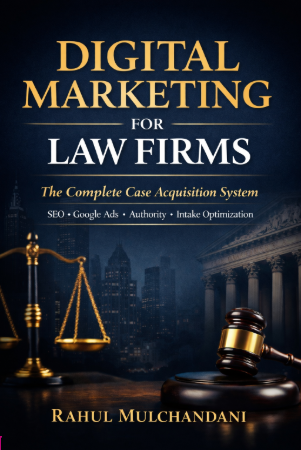
Author of "Digital Marketing For Lawyers" Book
Written by: Rahul Mulchandani
Founder, Digital Marketing Strategist and Author of "Digital Marketing For Lawyers" Book
Table of Contents
Litigation PPC is one of the most competitive and potentially profitable forms of legal marketing. When executed correctly, a well-structured pay-per-click campaign can place a litigation law firm directly in front of prospective clients at the exact moment they need legal representation.
Analyze this Litigation PPC for Lawyers content with AI tools:
ChatGPT Perplexity Grok Google AI ClaudeUnlike SEO, which can take months to generate meaningful visibility, Litigation PPC provides immediate exposure for high-intent searches such as “commercial litigation lawyer near me,” “business litigation attorney,” or “civil litigation lawyer consultation.” The challenge is that litigation-related keywords often carry some of the highest cost-per-click (CPC) rates in Google Ads, making strategic execution essential.
For litigation firms, success isn’t determined by traffic volume alone. It depends on attracting qualified cases, controlling acquisition costs, improving conversion rates, and maximizing return on advertising spend. This guide explains how Litigation PPC works, how leading firms structure campaigns, which metrics matter most, and how to generate profitable litigation leads consistently. Many litigation firms also work with a law firm seo agency to strengthen organic visibility, reduce reliance on expensive PPC traffic, and create a sustainable long-term lead generation strategy.
What Is Litigation PPC?
Litigation PPC refers to paid search advertising campaigns specifically designed to generate leads for litigation law firms.
Most litigation PPC campaigns operate through Google’s Search Network, where firms bid on keywords related to litigation services. When users search for relevant terms, ads appear above organic results.
Common litigation PPC keywords include:
Commercial litigation attorney
Civil litigation lawyer
Business litigation law firm
Contract dispute lawyer
Corporate litigation attorney
Litigation lawyer near me
Partnership dispute attorney
Shareholder litigation lawyer
Unlike broader legal marketing campaigns, litigation PPC focuses heavily on high-value cases where a single client may generate substantial legal fees.
Understanding Litigation Search Intent
One of the biggest differences between litigation PPC and other legal advertising campaigns is keyword intent.
Consider these examples:
| Search Query | Intent Level |
|---|---|
| What is commercial litigation | Informational |
| Commercial litigation process | Research |
| Commercial litigation attorney near me | High Intent |
| Business dispute lawyer consultation | High Intent |
| Hire litigation attorney | Immediate Intent |
Experienced PPC managers separate informational and transactional keywords to avoid wasting budget on research-stage users.
Why Litigation Keywords Are Expensive
Litigation-related searches often involve:
High-value cases
Long-term client relationships
Significant legal fees
Competitive markets
As a result, Google Ads auctions for litigation terms can produce CPCs ranging from $20 to well over $200 depending on market competitiveness, geographic targeting, and practice area specialization.
Why Litigation PPC Matters for Law Firms
Many litigation firms face a common challenge: referrals alone cannot consistently sustain growth.
While referrals remain valuable, PPC offers a scalable lead-generation channel that gives firms greater control over case acquisition.
Immediate Visibility
SEO may require six to twelve months before meaningful rankings develop. PPC can place a litigation firm at the top of search results within hours of campaign launch.
This is particularly useful for:
New firms
Expanding firms
Firms entering new markets
Firms launching new practice areas
Capturing High-Intent Prospects
Google’s search ecosystem provides access to prospects actively seeking legal help.
Someone searching:
“Commercial litigation lawyer Chicago”
is significantly closer to hiring counsel than someone casually reading litigation-related content.
Better Lead Quality
When campaigns use precise keyword targeting, firms often receive:
More qualified consultations
Higher-value cases
Lower intake screening costs
Better conversion rates
Measurable ROI
Unlike many traditional advertising channels, PPC provides detailed attribution data.
Using:
Google Ads Conversion Tracking
Google Analytics 4
CallRail
WhatConverts
firms can track:
Calls
Form submissions
Live chat leads
Signed cases
Revenue attribution
This transparency enables ongoing optimization.
How Litigation PPC Works
Understanding the mechanics behind PPC helps firms make smarter decisions.
Step 1: Keyword Research
Every successful campaign begins with keyword selection.
Tools commonly used include:
Google Keyword Planner
Semrush Keyword Magic Tool
Ahrefs Keywords Explorer
SpyFu
Google Search Console
Rather than targeting broad terms exclusively, litigation firms should build campaigns around:
Core Litigation Keywords
Examples:
litigation attorney
civil litigation lawyer
business litigation attorney
Practice-Specific Keywords
Examples:
contract dispute attorney
shareholder dispute lawyer
partnership litigation attorney
Geographic Keywords
Examples:
litigation lawyer Dallas
business litigation attorney Miami
civil litigation lawyer Atlanta
Step 2: Campaign Structure
Top-performing litigation campaigns separate keywords into tightly themed ad groups.
A strong structure might include:
| Campaign | Ad Groups |
|---|---|
| Commercial Litigation | Contract Disputes, Shareholder Disputes, Business Torts |
| Civil Litigation | Property Disputes, Consumer Claims |
| Business Litigation | Partnership Disputes, Corporate Litigation |
| Local Litigation | City-Specific Keywords |
This improves Quality Score and ad relevance.
Step 3: Ad Creation
Google evaluates:
Expected CTR
Ad Relevance
Landing Page Experience
These form the foundation of Quality Score.
Strong litigation ads typically include:
Practice area
Geographic reference
Trust indicator
Call to action
Example:
Commercial Litigation Attorney
Protect Your Business Interests. Experienced Trial Lawyers. Schedule Your Consultation Today.
Get More Clients for Your Law Firm
Stop losing potential cases to competitors. Let’s build a strategy that brings you consistent, high-quality leads.
Building a High-Performance Litigation PPC Campaign
Campaign architecture often determines success before the first click occurs.
Match Types Matter
Modern PPC campaigns typically utilize:
Exact Match
Targets highly specific searches.
Example:
[commercial litigation attorney]
Provides greater control and stronger lead quality.
Phrase Match
Captures keyword variations.
Example:
“business litigation lawyer”
Allows broader reach while maintaining relevance.
Negative Keywords
Negative keywords are among the most overlooked optimization tools.
Examples:
free
jobs
salary
definition
school
course
internship
Google Ads’ Search Terms Report should be reviewed weekly to identify wasteful traffic.
Geographic Targeting
Most litigation firms should target:
Service area cities
Counties
Metro areas
Avoid nationwide targeting unless the firm handles federal or multi-jurisdictional matters.
Ad Extensions
Google now refers to extensions as Assets.
High-performing litigation campaigns commonly use:
Call Assets
Location Assets
Structured Snippets
Sitelinks
Callout Assets
These improve visibility and CTR.
Landing Pages and Conversion Optimization
Many law firms focus heavily on ads while neglecting landing pages.
This often becomes the biggest bottleneck.
Dedicated Landing Pages Convert Better
A litigation PPC campaign should never send visitors to a generic homepage.
Instead, create dedicated pages focused on:
Commercial litigation
Business disputes
Contract litigation
Civil litigation
Essential Litigation Landing Page Elements
Strong Headline
Visitors should immediately know:
What the firm does
Who it helps
What action to take
Trust Signals
Examples include:
Bar memberships
Attorney awards
Trial experience
Published case results
Client reviews
Clear Calls-to-Action
Examples:
Schedule Consultation
Speak With an Attorney
Request Case Evaluation
Mobile Optimization
More than half of legal PPC traffic now originates from mobile devices.
Landing pages should prioritize:
Click-to-call functionality
Fast load speeds
Easy form completion
Responsive design
Core Web Vitals
Google’s page experience signals include:
Largest Contentful Paint (LCP)
Interaction to Next Paint (INP)
Cumulative Layout Shift (CLS)
Poor performance can negatively affect both Quality Score and conversion rates.
Budgeting, Bidding, and Performance Metrics
One of the most common questions law firms ask is how much they should spend on litigation PPC.
The answer depends on:
Market size
Competition
Practice focus
Revenue per case
Budget Framework
A firm seeking 20 qualified leads monthly might estimate:a
| Metric | Example |
|---|---|
| Average CPC | $75 |
| Conversion Rate | 8% |
| Lead Goal | 20 |
| Required Clicks | 250 |
| Monthly Budget | $18,750 |
Actual costs vary significantly by geography and litigation specialty.
Bidding Strategies
Maximize Conversions
Useful during early optimization phases.
Target CPA
Effective once sufficient conversion data exists.
Google generally recommends at least 30 conversions monthly before relying heavily on automated bidding.
Target ROAS
Particularly useful for firms tracking signed-case revenue.
Metrics That Matter
Track:
Cost Per Click
Conversion Rate
Cost Per Lead
Qualified Lead Rate
Signed Case Rate
Cost Per Acquisition
Return on Ad Spend
Many firms incorrectly focus only on clicks and impressions.
Revenue remains the ultimate metric.
Common Litigation PPC Mistakes
Targeting Broad Keywords
Broad targeting often generates:
Irrelevant searches
Research traffic
Lower lead quality
Ignoring Intake Quality
Marketing teams sometimes optimize for form submissions rather than retained clients.
Track actual case outcomes whenever possible.
Weak Conversion Tracking
Without proper tracking, optimization becomes guesswork.
Every campaign should measure:
Calls
Forms
Chats
Consultation bookings
Sending Traffic to Homepages
Dedicated landing pages almost always outperform generic homepages.
Neglecting Search Terms Reports
Reviewing search queries frequently helps uncover:
New keyword opportunities
Budget waste
Negative keyword candidates
Advanced Litigation PPC Strategies
Remarketing
Many litigation prospects do not convert on their first visit.
Remarketing allows firms to re-engage:
Website visitors
Consultation abandoners
Content consumers
Competitor Campaigns
Some firms bid on competitor brand names.
Success depends on:
Local competition
Ethical advertising rules
Budget efficiency
Audience Layering
Google Ads allows firms to observe and optimize for audiences such as:
Business professionals
Company decision makers
In-market legal services users
Audience insights can improve bid adjustments and messaging.
First-Party Data Strategies
As privacy regulations evolve, first-party data becomes increasingly valuable.
Litigation firms should integrate:
CRM systems
Call tracking
Lead qualification scoring
Offline conversion imports
Importing signed-case data back into Google Ads can dramatically improve Smart Bidding performance.
The Future of Litigation PPC
Several trends are shaping legal advertising.
AI-Powered Campaign Management
Google’s automated bidding systems continue to become more sophisticated.
Firms that provide accurate conversion data generally outperform those relying solely on manual optimization.
Performance Max Expansion
Although Search remains dominant for litigation campaigns, Performance Max increasingly supports lead generation through:
Search
Display
YouTube
Discover
Gmail
Enhanced First-Party Tracking
Privacy changes continue to reduce third-party tracking effectiveness.
Future-ready firms are implementing:
Enhanced Conversions
Server-side tagging
CRM integrations
Greater Emphasis on Conversion Quality
Google’s machine learning increasingly rewards advertisers who upload qualified lead and revenue data rather than simple form completions.
Firms able to connect marketing activity to retained clients will gain a significant competitive advantage.
Measuring Success in Litigation PPC
Effective Litigation PPC campaigns should be evaluated based on business outcomes rather than clicks alone. While metrics such as impressions and click-through rates provide visibility into campaign performance, the ultimate objective is generating profitable litigation cases. Pasted text.txt
Law firms should monitor the following key performance indicators (KPIs):
- Cost Per Lead (CPL): The amount spent to generate a consultation request or phone call. Pasted text.txt
- Qualified Lead Rate: The percentage of leads that match the firm’s ideal client profile and practice focus. Pasted text.txt
- Consultation Booking Rate: The percentage of inquiries that convert into scheduled consultations.
- Signed Case Rate: The number of consultations that ultimately become retained clients. Pasted text.txt
- Cost Per Acquisition (CPA): Total advertising spend divided by the number of retained cases. Pasted text.txt
- Return on Ad Spend (ROAS): Revenue generated compared to total ad spend. Pasted text.txt
- Call and Form Conversion Rates: Tracking calls, forms, chats, and offline conversions helps determine campaign effectiveness. Pasted text.txt
Successful litigation firms also integrate CRM systems and offline conversion tracking to connect Google Ads performance directly to signed cases and revenue. This allows automated bidding strategies to optimize toward the highest-value matters rather than simple lead volume.
Case Study: Litigation Firm Increases Qualified Leads by 167% Through PPC Optimization
A mid-sized business litigation firm operating in a highly competitive metropolitan market was struggling with rising advertising costs and inconsistent lead quality. The firm relied heavily on broad-match keywords and directed all paid traffic to its homepage, resulting in wasted ad spend and low conversion rates.
Challenges
- High cost-per-click exceeding $120 for several litigation terms.
- Poor lead quality from broad, research-focused searches.
- No dedicated landing pages for practice-specific campaigns.
- Limited conversion tracking that measured only form submissions.
Strategy Implemented
The firm restructured its Google Ads account by:
- Segmenting campaigns into tightly themed ad groups for commercial litigation, contract disputes, and shareholder disputes. Pasted text.txt
- Shifting budget toward exact-match and phrase-match high-intent keywords. Pasted text.txt
- Implementing an extensive negative keyword list to eliminate irrelevant searches. Pasted text.txt
- Creating dedicated landing pages for each litigation service area. Pasted text.txt
- Adding call tracking, CRM integration, and offline conversion imports to measure retained cases. Pasted text.txt
Results After Six Months
Metric | Before | After |
Monthly Qualified Leads | 18 | 48 |
Conversion Rate | 4.9% | 13.1% |
Cost Per Qualified Lead | $1,150 | $640 |
Consultation Booking Rate | 31% | 57% |
Signed Cases Per Month | 4 | 11 |
Return on Ad Spend | 2.8x | 6.4x |
Outcome
By focusing on high-intent search terms, dedicated landing pages, and revenue-based optimization, the firm increased qualified litigation inquiries by 167% while reducing acquisition costs by 44%. The campaign ultimately generated a substantial increase in retained high-value litigation matters, demonstrating that precise targeting and robust conversion tracking are essential for long-term PPC profitability.
Next Steps
If you’re evaluating or improving a Litigation PPC strategy, begin with a complete audit of your keyword targeting, campaign structure, landing pages, and conversion tracking setup. Identify where budget is being wasted, review search terms for irrelevant traffic, and verify that every lead source is accurately measured. Once tracking is reliable, focus on improving lead quality rather than simply increasing lead volume. The most successful litigation PPC campaigns are built on precise targeting, strong landing page experiences, and ongoing optimization based on signed-case outcomes rather than vanity metrics.
Frequently Asked Questions
What is Litigation PPC?
Litigation PPC is a paid advertising strategy that helps litigation law firms generate leads through platforms like Google Ads.
How much does Litigation PPC cost?
Costs vary by market and keyword competition, but litigation-related clicks can range from $20 to over $200 per click.
Is Litigation PPC better than SEO?
PPC delivers immediate visibility, while SEO builds long-term organic traffic. Many firms use both for maximum results.
Which keywords work best for Litigation PPC?
High-intent keywords such as “commercial litigation attorney,” “business litigation lawyer,” and “civil litigation attorney near me” typically perform best.
How quickly can Litigation PPC generate leads?
Most campaigns begin generating clicks and inquiries within days of launching, provided targeting and tracking are properly configured.
What is a good conversion rate for Litigation PPC?
Many successful litigation campaigns achieve conversion rates between 5% and 15%, depending on lead quality and landing page performance.
Why are litigation keywords so expensive?
Litigation cases often have high revenue potential, which increases advertiser competition and drives up CPCs.
Do I need a dedicated landing page?
Yes. Dedicated litigation landing pages usually convert better than sending visitors to a law firm’s homepage.
What metrics should litigation firms track?
Focus on cost per lead, conversion rate, qualified leads, retained cases, and return on ad spend rather than clicks alone.
Can small law firms benefit from Litigation PPC?
Yes. Even smaller firms can compete effectively by targeting specific practice areas, locations, and high-intent keywords.
🚀 Get Free Consultation
Our Latest Posts
-
 How We Generate Signed Cases for Lawyers: 7 Proven Strategies That Deliver Real Results
 -
 Case Study: Multi-City Personal Injury SEO Success – New Mexico
 -
 Case Study: Personal Injury Lawyer in Texas
 -
 Lawyer SEO: The Complete Guide to Optimizing Law Firm Websites for Clients and Rankings
 -
 Why Lawyer Switch to Us
Updated on
Get In Touch with Us!
other way to contact us
Office Email
rahul@webkeydigital.com
Office Phone
+1 503-303-8639
Office Location
8 The Green STE A, Dover, Kent , Delaware 19901